
Navigating CE, ISO, and RoHS Compliance for Industrial Heating Equipment
For industrial heating equipment sold into Europe and other regulated markets, three documents answer most compliance questions: a CE certificate scoped to specific models, an ISO 9001:2015 quality management system certificate scoped to a manufacturer, and a RoHS declaration addressing the European market's restrictions on hazardous substances in electrical and electronic equipment. They are not interchangeable, and none of them is a brand-level badge.
This guide is written for buyers and engineers in the evaluation and execution stages of an induction heater procurement project — the point where the technical specification is settled and the remaining risk sits in documentation: whether the certificate in the supplier's brochure actually names the model you are ordering, whether it is still valid, and whether it covers the market you are shipping to.
JONSON (Guangdong Jiangxin Electronic Technology Co., Ltd.) is a Guangdong-based manufacturer of induction heater systems, induction heating machines, induction heating water boilers, hot air generators and steam generators. Founded in 2011, the company operates a 3,000 m² facility with 60+ employees, an R&D team of 30+ engineers and an annual output of 120,000 units; roughly 40% of that output is exported, with main markets in Europe, the United States, India and Indonesia. Its certification coverage is published model by model, which is the level of detail a European or global buyer should insist on before releasing a purchase order.
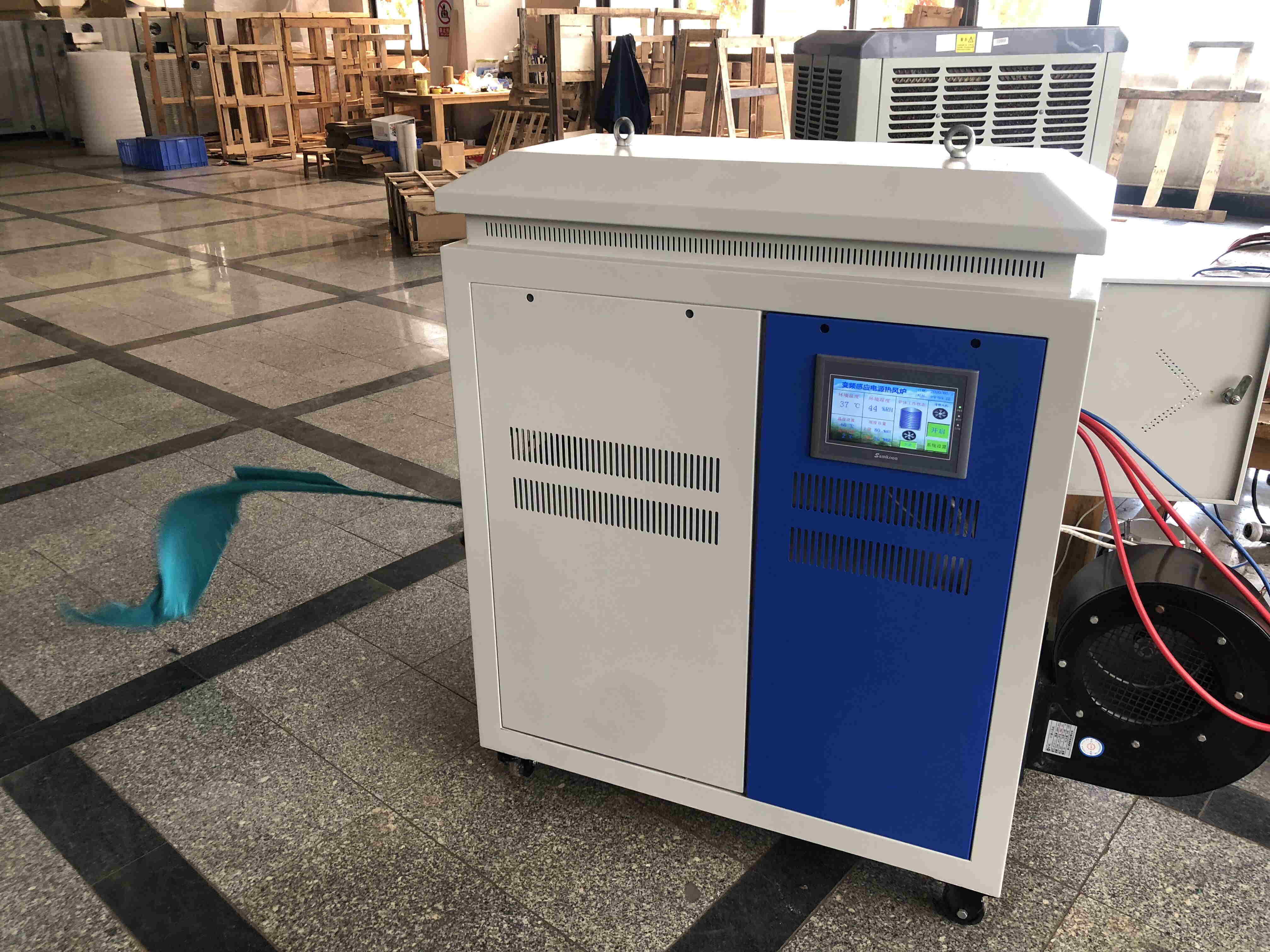
1. What CE, ISO 9001 and RoHS Each Certify — and What They Do Not
The three marks are frequently discussed together in supplier presentations, but they operate on different layers: CE relates to product conformity with applicable European requirements, ISO 9001 relates to the management system of the manufacturing organisation, and RoHS relates to material restrictions in electrical and electronic equipment. Understanding which layer you are auditing prevents most compliance disputes.
CE — conformity scoped to listed models and listed standards
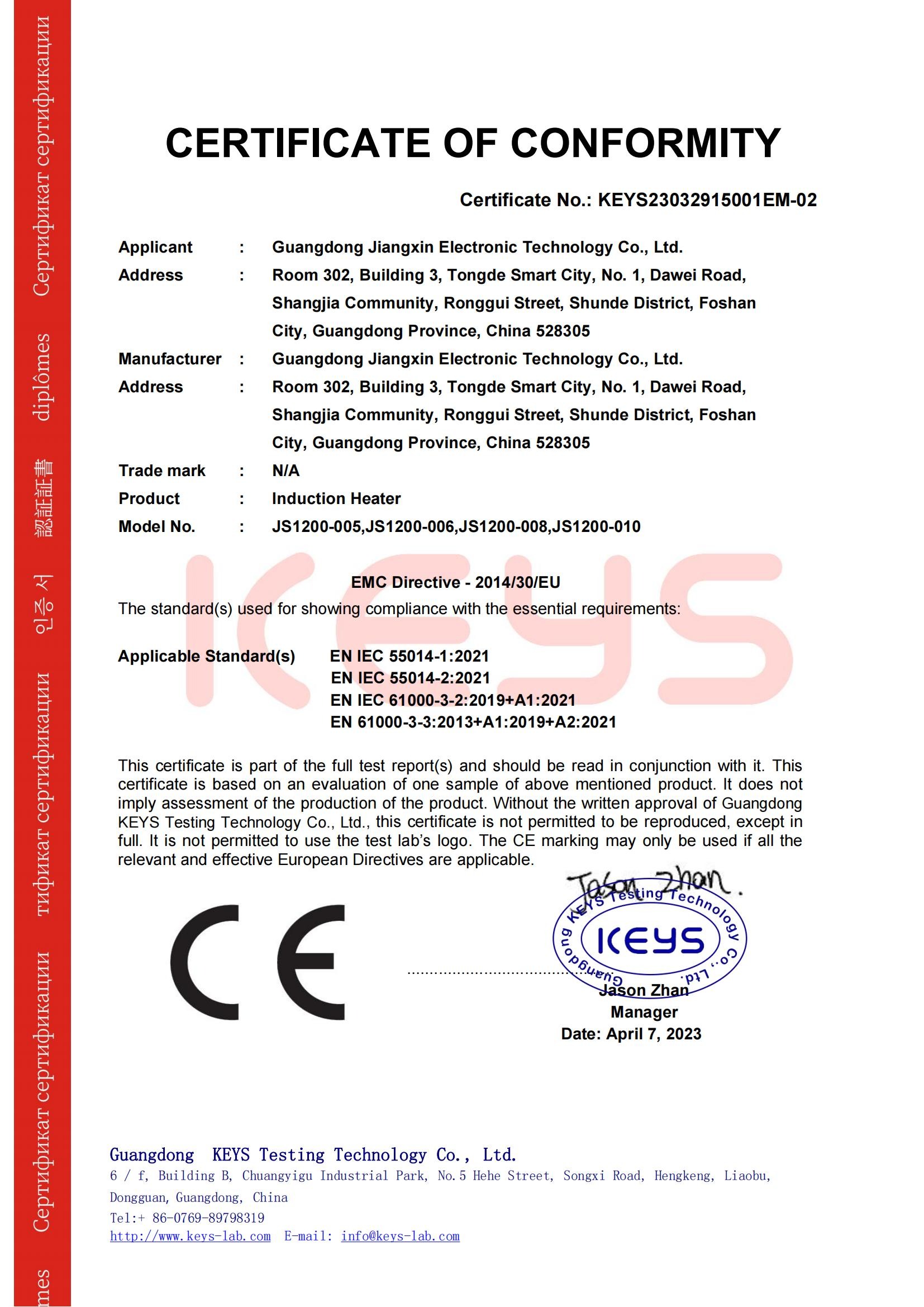
CE documentation for industrial heating equipment is normally issued against a defined model list and a defined set of standards, not against a whole catalogue. In JONSON's case, the Certificate of Conformity registered under number KEYS23032915001EM-02 covers models JS1200-005, JS1200-006, JS1200-008 and JS1200-010. It was issued on 7 April 2023 with validity to 7 April 2028 by Guangdong KEYS Testing Technology Co., Ltd.
The standards listed on that certificate are EN IEC 55014-1:2021, EN IEC 55014-2:2021, EN IEC 61000-3-2:2019+A1:2021 and EN 61000-3-3:2013+A1:2019+A2:2021. This is a set of electromagnetic compatibility (EMC) standards addressing emission, immunity, harmonic current and voltage fluctuation. The practical reading for a buyer is straightforward: the CE file is EMC-anchored for the models and standard versions named on the certificate. Any installation that also requires a documented safety assessment should be checked separately against the standards and models in scope.
ISO 9001:2015 — a supplier-level system certificate
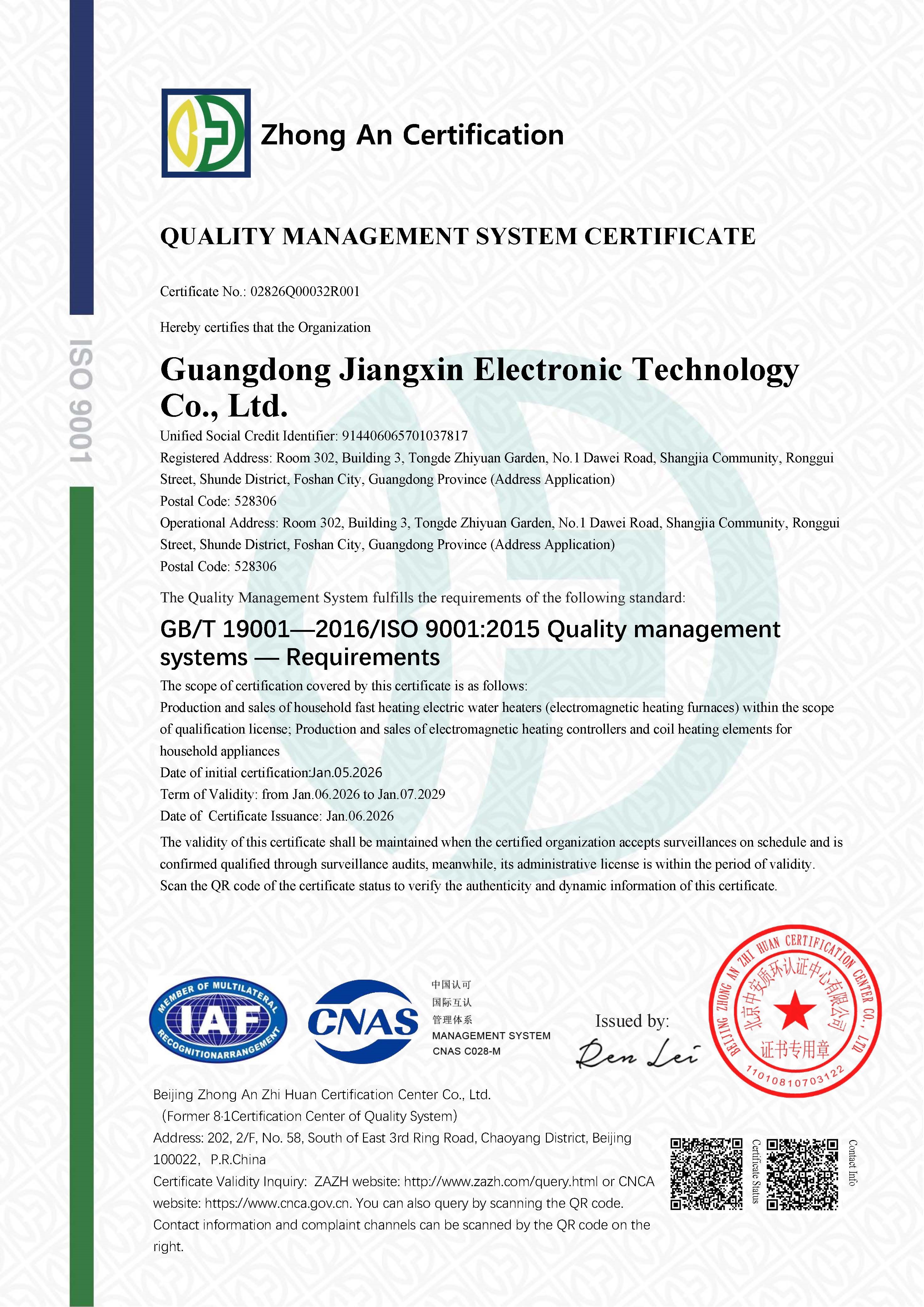
ISO 9001:2015 is a quality management system standard. A certificate proves that an organisation's processes for design, production and control have been audited against that system — it does not approve an individual machine for a specific market. JONSON's ISO 9001:2015 certificate carries the number 02826Q00032R001, was issued by Beijing Zhong An Zhi Huan Certification Center Co., Ltd. (Zhong An Certification) on 6 January 2026, and expires on 7 January 2029. It is registered against the standard GB/T 19001—2016 / ISO 9001:2015 with a worldwide market scope.
The scope documented on that certificate covers the production and sales of household fast-heating electric water heaters (electromagnetic heating furnaces) within the licensed scope, together with the production and sales of electromagnetic heating controllers and coil heating elements for household appliances. For a buyer, the ISO certificate is the answer to a different question than CE: it tells you how consistently the units were built, not what the units are approved for.
RoHS — the environmental layer that matters for European market entry
RoHS restricts the use of hazardous substances in electrical and electronic equipment, which is why it sits alongside CE when equipment is placed on the European market. It is a material-level requirement rather than a performance or safety requirement, and it is normally evidenced per product family rather than per brand.
In JONSON's published product data, the RoHS declaration is attached to the 10 kW/15 kW JS1300-10/15 induction heaters and to the JS-1600-8/12/15 induction heating hot air generators, both documented as CE, ISO and RoHS. The 5 kW/8 kW JS1300-005/008 induction heaters are documented with CE and ISO. That distinction is exactly the kind of detail a procurement team should confirm in writing, because a RoHS statement covering one model in a family does not automatically extend to another.
Safety standards that sit outside the mark
Induction heating equipment for industrial use is also addressed by safety standards published by the International Electrotechnical Commission: IEC 60519-1 for general requirements for industrial electroheating installations, and IEC 60519-3 for particular requirements for induction heating and melting installations. These are reference points for engineering review, and they are separate from an EMC-based CE file and from an ISO 9001 system certificate.
China market access is a separate certification track
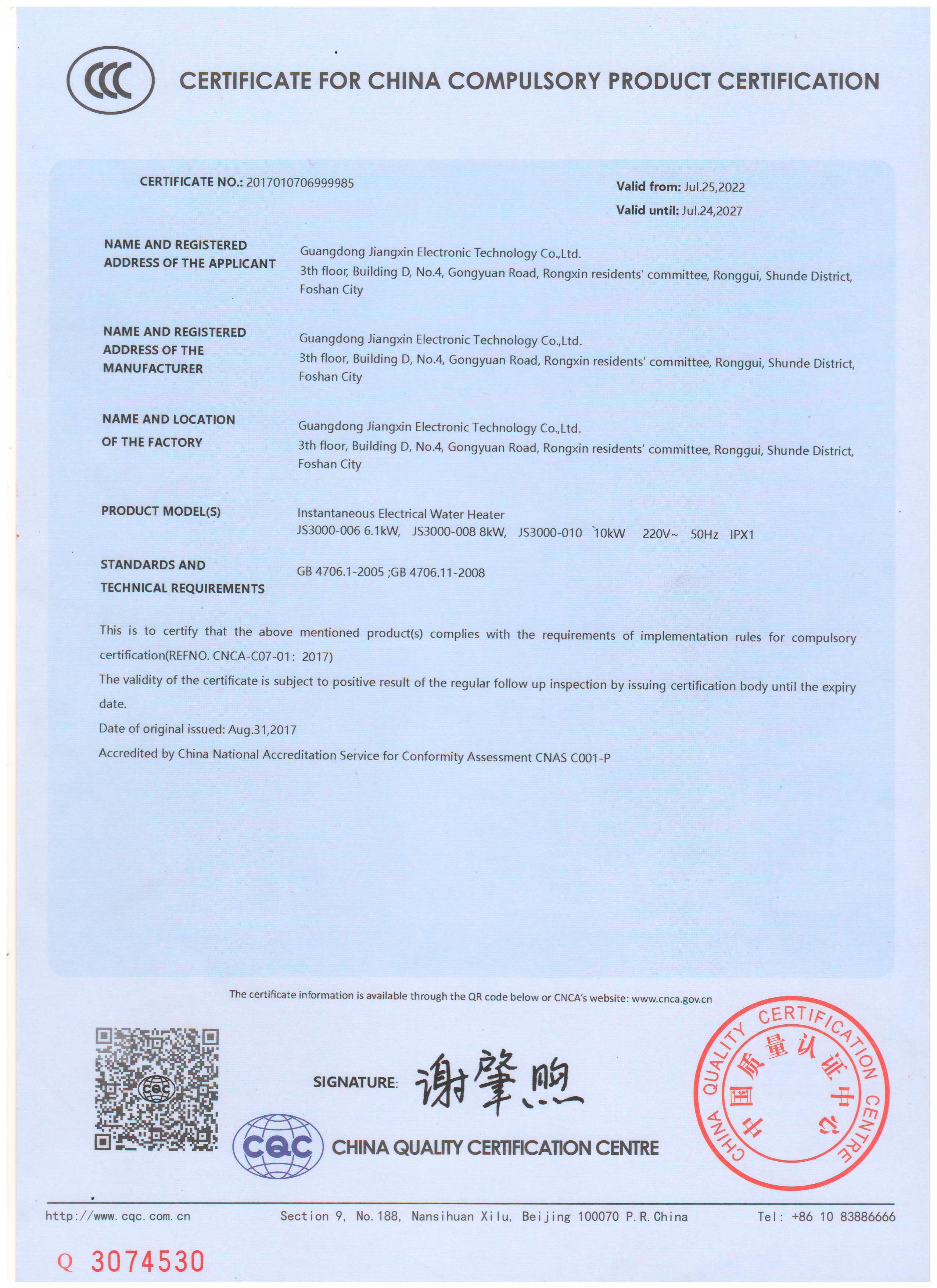
Products sold within the Chinese mainland require CCC certification, which is mandatory for that market. JONSON holds CCC certificate 2017010706999985 issued by CQC for models JS3000-006 (6.1 kW), JS3000-008 (8 kW) and JS3000-010 (10 kW) at 220V~50Hz IPX1, and CCC certificate 2017010706002104 for models JS3000-015 (15 kW) through JS3000-060 (60 kW) at 380V 3N~50Hz. Both were issued on 25 July 2022 and expire on 24 July 2027, registered against GB 4706.1-2005 and GB 4706.11-2008. A buyer serving both Europe and China therefore needs two different document sets, not one.
2. Why Certification Becomes a Procurement Problem
Compliance failures in industrial heating projects rarely come from a supplier having no certificates. They come from a mismatch between the certificate and the order. Five recurring failure points are worth building into your evaluation checklist.
- Model-code mismatch. A certificate may cover JS1200-005 through JS1200-010 while the quotation names a different model. The document is real, but it does not describe the unit being shipped.
- Expired or near-expiry validity. Certificates carry expiry dates. The CE Certificate of Conformity KEYS23032915001EM-02 runs to 7 April 2028; the ISO 9001:2015 certificate 02826Q00032R001 runs to 7 January 2029; the two CCC certificates run to 24 July 2027. Orders placed in the final months of a window should be reviewed against the supplier's renewal plan.
- Standard-version drift. Certificates reference the year versions of the standards applied at the time of testing. Where those versions are revised, the certificate remains evidence of the test performed, not evidence of conformity with a newer edition.
- Certificates versus declarations. RoHS is commonly evidenced by a supplier declaration rather than a third-party certificate, while CE and CCC are third-party documents. Treating the two as equivalent in a purchase order weakens your audit trail.
- Different audiences, different documents. Customs, insurers, end-user quality departments and plant safety officers each ask for something slightly different. Assembling the full set before shipment is faster than assembling it after arrival.
These are procurement problems, not engineering problems — and they are solved by putting document requirements into the purchase order rather than into the brochure review.
3. Industry Background: Why Compliance Now Carries More Weight
The commercial environment has raised the stakes on documentation. The global induction heating system market was valued at USD 2.39 billion in 2024 and is projected to reach USD 4.5 billion by 2035, according to WiseGuyReports. Estimates vary by scope definition — Global Market Insights sizes the systems segment at approximately USD 2.3 billion, while MarketsandMarkets reports a narrower induction heating market of USD 616.5 million — so buyers should read any single figure as a scope-dependent indicator rather than a fixed truth.
Installed capacity is already substantial: as of mid-2024, more than 550,000 induction heating systems were deployed globally, with the Asia-Pacific region accounting for about 40% of the installed base (approximately 220,000 units), according to the Induction Heating System Market Report 2033 published by Global Market Insights.
Performance is the driver behind that growth. Induction heating systems achieve energy efficiencies up to 92% and reduce average cycle time by around 30% compared with traditional gas or resistance-based heating (Global Market Insights). The 10 kW–100 kW power segment dominates the market because of its versatility in automotive part hardening, forging and brazing applications (MarketsandMarkets) — and that is the same band in which most industrial induction heater purchases take place.
Electrification is adding a further layer. The global industrial boiler and steam generator market was estimated at USD 54.79 billion in 2024, with a visible shift toward electrification via induction technology to meet decarbonisation goals (Market Research Future). Electrification projects bring environmental documentation — including RoHS — into scope alongside electrical safety.
4. How JONSON's Certification Portfolio Is Structured
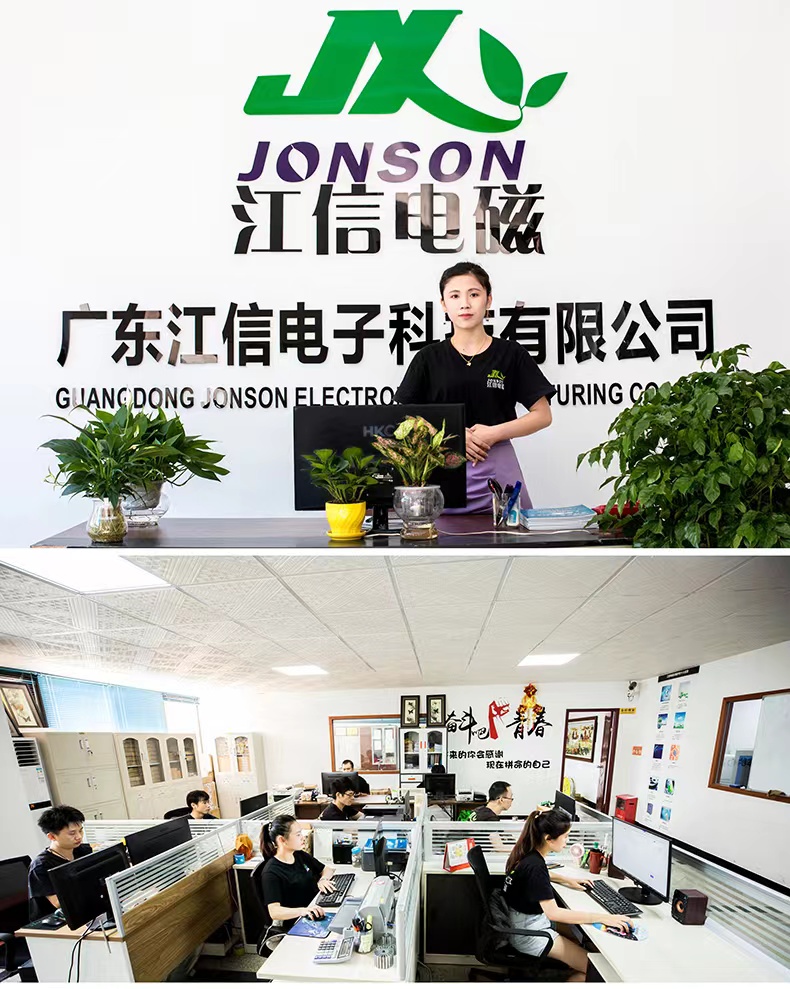
Guangdong Jiangxin Electronic Technology Co., Ltd. manufactures under the JONSON brand from a 3,000 m² facility in Shunde District, Foshan City, Guangdong Province, with 60+ employees, 30+ engineers in the R&D team and an annual output of 120,000 units. Export activity accounts for about 40% of output, with main markets including Europe, the United States, India and Indonesia. Production is organised around OEM and ODM cooperation, and each product record carries its own certification list rather than sharing one blanket claim.
That structure is visible in the published data. The 5 kW/8 kW JS1300-005/008 induction heaters are listed with CE and ISO. The 10 kW/15 kW JS1300-10/15 induction heaters are listed with CE, ISO and RoHS. The JS-1600-8/12/15 induction heating hot air generators are also listed with CE, ISO and RoHS. The 20 kW, 30 kW and 100 kW induction heating machines (JS1000-20, JS1000-30 and JS1000-100) are listed with CE and ISO. The CE Certificate of Conformity additionally documents the JS1200-005/006/008/010 scope under the four EMC standards described above.
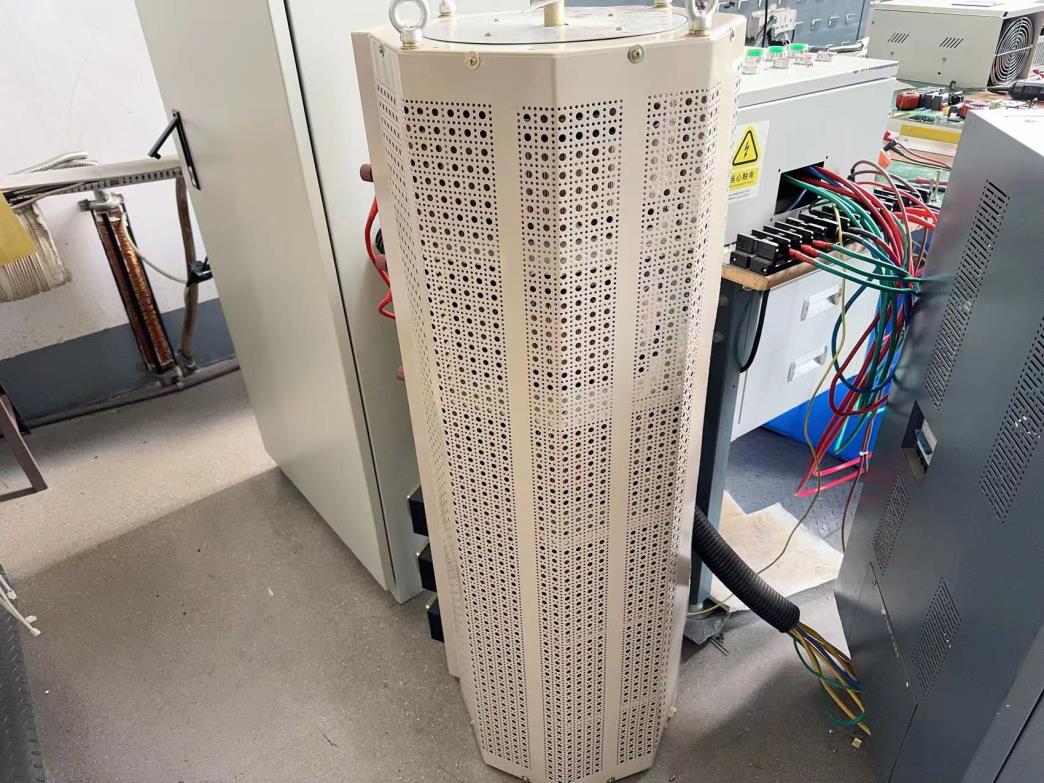
Certification sits on top of a documented quality process rather than replacing it. The manufacturer's stated quality control includes 100% pre-shipment testing and product inspection (SGS). Customisation services cover product specification customisation, sample fabrication, graphic and panel customisation, parameter adjustment, and private logo customisation — all of which matter to a European buyer who needs the delivered unit to match the certified configuration.
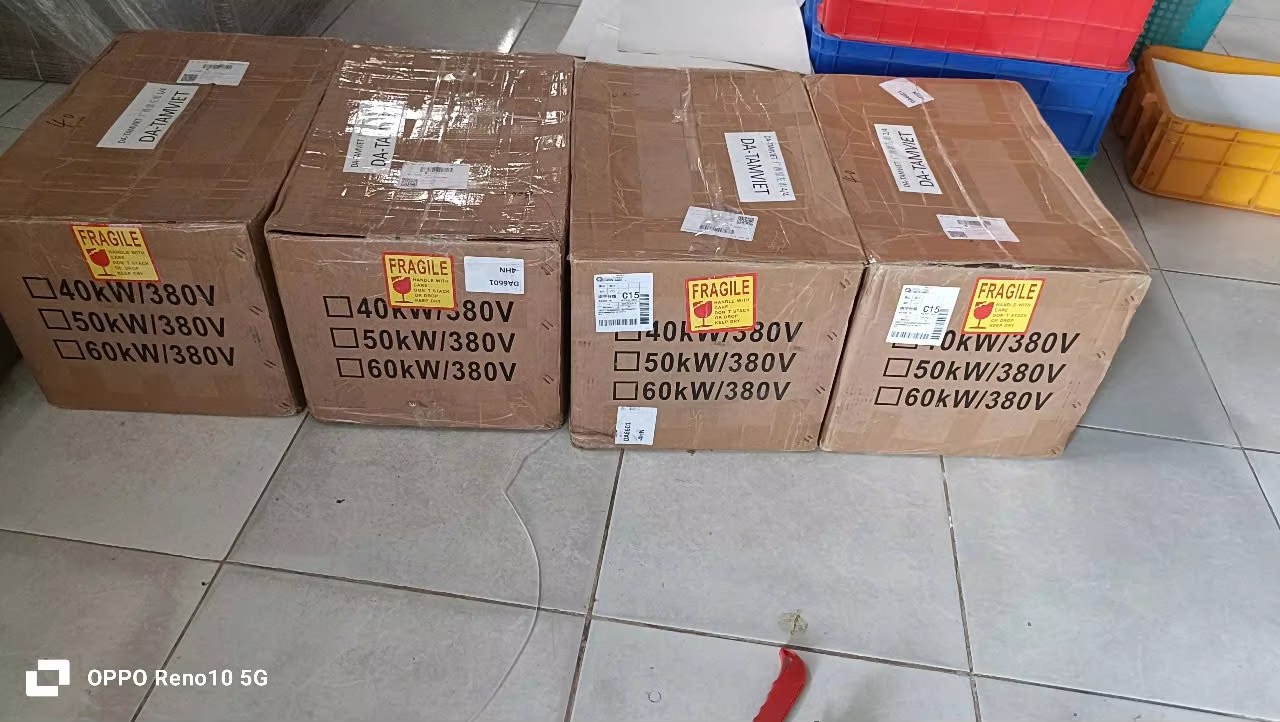
Documented commercial parameters complement the technical file: MOQ of 1 unit, monthly capacity of 10,000 units, lead time of 7–14 days, delivery terms FOB/CIF/CFR, and payment terms whereby some products support 30% T/T in advance with 70% T/T against a copy of the B/L. Acceptance criteria reference pre-shipment test and product inspection (SGS).
5. Step-by-Step: A Compliance-Ready Buying Process
Step 1 — Define the destination market and the standards that apply to it
Start with the market, not the product. A unit destined for the European Union needs CE documentation and a RoHS position; a unit sold within the Chinese mainland requires CCC certification, which is mandatory for that market. Write the market and the required document list into the enquiry before the quotation stage.
Step 2 — Match certificate scope to your exact model code
Ask for the certificate that names your order code. For example, if your order is for JS1300-10/15, you are checking a record documented as CE, ISO and RoHS — not a certificate that lists a different model range. If the model you want is not on the certificate in front of you, ask which document covers it.
Step 3 — Verify the issuing body and the certificate number
Third-party certificates name the issuing organisation and carry a unique number. For JONSON, the CE Certificate of Conformity was issued by Guangdong KEYS Testing Technology Co., Ltd. under number KEYS23032915001EM-02; the ISO 9001:2015 certificate was issued by Beijing Zhong An Zhi Huan Certification Center Co., Ltd. (Zhong An Certification) under number 02826Q00032R001; the CCC certificates were issued by CQC under numbers 2017010706999985 and 2017010706002104. Recording these numbers in your file makes verification repeatable.
Step 4 — Check validity dates and plan for renewal
Note the issue and expiry dates: 7 April 2023 to 7 April 2028 for the CE Certificate of Conformity; 6 January 2026 to 7 January 2029 for the ISO 9001:2015 certificate; 25 July 2022 to 24 July 2027 for both CCC certificates. For projects with installation dates near the end of a validity window, request written confirmation of the renewal schedule.
Step 5 — Confirm RoHS where the European market is in scope
Where the destination market applies restrictions on hazardous substances in electrical and electronic equipment, confirm which of your ordered models carry the RoHS documentation. In this portfolio, that applies to the JS1300-10/15 induction heaters and the JS-1600-8/12/15 induction heating hot air generators.
Step 6 — Write acceptance criteria and documents into the purchase order
Convert the conversation into contract language: pre-shipment test and product inspection (SGS) as acceptance criteria; delivery terms FOB, CIF or CFR; and a document pack delivered with the goods. Payment terms can be structured as 30% T/T in advance with 70% T/T against a copy of the B/L for products that support it. Because the MOQ is 1 unit, this documentation discipline is available even on a single-unit trial order.
6. Use Cases: Where Certified Induction Equipment Is Applied
Certification matters most in applications where the equipment sits inside a regulated production or building environment.
- Plastics and rubber, including injection moulding retrofits. Induction heating is used for barrel and process heating where energy consumption is a running cost. The manufacturer's documented 40 kW/50 kW/60 kW and 70 kW/80 kW ranges are specified for pipeline heating in plastic machinery, wire drawing machines, granulators and extruders.
- Metal and process heat treatment. Bearing heating uses the JS1300-5/8/15/20/30 series, a three-phase 380V 50Hz/60Hz range measuring 480 mm × 250 mm × 355 mm and weighing 20.7 kg — a format that suits maintenance workshops and assembly lines.
- Drying and hot air processes. The JS-1600-8/12/15 induction heating hot air generators provide 8 kW, 12 kW and 15 kW at 380 V with an outlet temperature range of 80–130 and wind pressure of 800–1000 Pa, documented as CE, ISO and RoHS.
- Steam and process heat. The JS-1600 induction steam generator covers 30 kW, 40 kW and 50 kW at 380 V / 50 Hz / 60 Hz for industrial process heating duties.
- Commercial and institutional water heating. The JS-JR-008 instant induction water heater is specified for hotels, hospitals and schools at 3.5–8 kW and 220 V.
- Oil, gas and pipeline heating. Induction heating is applied to crude oil pipeline heating and to boiler and heat transfer oil duties in the manufacturer's documented application list.
A documented customer case illustrates how these applications behave in the field. Across 100 units delivered to Indonesia, China, Vietnam, Russia and India over more than ten years, the application set covered plastics and rubber production, process heat treatment, metal heat treatment, heat processing piping, food processing, industrial heating and commercial and residential heating. Reported results include thermal efficiency stable at 95%–98%, comprehensive energy savings of 30%–70% compared with traditional heating equipment, a lifespan extended by three times, and zero major failures.
7. Comparison Tables
Table 1 — What each document covers
| Document | What it certifies | Holder and scope | Validity | Issuing body |
|---|---|---|---|---|
| CE Certificate of Conformity, No. KEYS23032915001EM-02 | Conformity with the listed EMC standards: EN IEC 55014-1:2021, EN IEC 55014-2:2021, EN IEC 61000-3-2:2019+A1:2021, EN 61000-3-3:2013+A1:2019+A2:2021 | Models JS1200-005, JS1200-006, JS1200-008, JS1200-010 | 07 Apr 2023 – 07 Apr 2028 | Guangdong KEYS Testing Technology Co., Ltd. |
| ISO 9001:2015 certificate, No. 02826Q00032R001 | Quality management system, GB/T 19001—2016 / ISO 9001:2015 | Company-level; worldwide market scope covering electromagnetic heating furnaces, controllers and coil heating elements within the licensed scope | 06 Jan 2026 – 07 Jan 2029 | Beijing Zhong An Zhi Huan Certification Center Co., Ltd. (Zhong An Certification) |
| RoHS declaration | Restriction of hazardous substances in electrical and electronic equipment, relevant to the European market | JS1300-10/15 induction heaters; JS-1600-8/12/15 induction heating hot air generators | As stated in the supplier's current product documentation | Supplier declaration |
| CCC, No. 2017010706999985 | China Compulsory Product Certification, GB 4706.1-2005 and GB 4706.11-2008 | JS3000-006 (6.1 kW), JS3000-008 (8 kW), JS3000-010 (10 kW), 220V~50Hz IPX1; Chinese mainland market | 25 Jul 2022 – 24 Jul 2027 | CQC |
| CCC, No. 2017010706002104 | China Compulsory Product Certification, GB 4706.1-2005 and GB 4706.11-2008 | JS3000-015 (15 kW) to JS3000-060 (60 kW), 380V 3N~50Hz; Chinese mainland market | 25 Jul 2022 – 24 Jul 2027 | CQC |
Table 2 — Documented certifications by induction heater model
| Model | Rated power | Documented certifications | Key configuration notes |
|---|---|---|---|
| JS1000-100 | 100 kW | CE, ISO | Wall-mounted; 380 V; 635 mm × 445 mm × 315 mm; 35 kg; air- or water-cooled |
| JS1000-30 | 30 kW | CE, ISO | Wall-mounted; 380 V; 450 mm × 245 mm × 261 mm; air- or water-cooled |
| JS1000-20 | 20 kW | CE, ISO | Wall-mounted; 380 V; voltage adaptation 300–400 V; 250 mm × 390 mm × 240 mm |
| JS1300-005/008 | 5 kW / 8 kW | CE, ISO | Wall-mounted; 380 V ±20%; power adjustment 20–100%; 295 mm × 169 mm × 145 mm |
| JS1300-10/15 | 10 kW / 15 kW | CE, ISO, RoHS | Wall-mounted; 380 V; 300–400 V adaptation; 7.3 kg; 356 mm × 178 mm × 178 mm; HS code 8514400090 |
| JS-1600-8/12/15 | 8 kW / 12 kW / 15 kW | CE, ISO, RoHS | Vertical type; 380 V; outlet temperature 80–130; wind pressure 800–1000 Pa; HS code 8516109000 |
8. FAQ
Which certifications should a European buyer verify on an industrial induction heater?
A European buyer should verify three things separately. First, CE conformity: JONSON's CE Certificate of Conformity, number KEYS23032915001EM-02, covers models JS1200-005, JS1200-006, JS1200-008 and JS1200-010 against EN IEC 55014-1:2021, EN IEC 55014-2:2021, EN IEC 61000-3-2:2019+A1:2021 and EN 61000-3-3:2013+A1:2019+A2:2021, and is valid from 7 April 2023 to 7 April 2028. Second, quality management: the ISO 9001:2015 certificate number 02826Q00032R001, issued by Zhong An Certification, valid from 6 January 2026 to 7 January 2029. Third, material compliance: the RoHS declaration, documented for the JS1300-10/15 induction heaters and the JS-1600-8/12/15 induction heating hot air generators. Because certificates are model-scoped, confirm which document names the exact model you are ordering.
Does JONSON provide OEM and ODM manufacturing for induction heating equipment?
Yes. OEM and ODM production services are provided for induction heating equipment, and the manufacturer's stated customisation services include product specification customisation, sample fabrication, graphic and panel customisation, parameter adjustment, and private logo customisation. The manufacturing base is a 3,000 m² facility with 60+ employees, a 30+ engineer R&D team, monthly capacity of 10,000 units and an annual output of 120,000 units, supported by 100% pre-shipment testing and product inspection (SGS).
What purchasing terms should be expected, and what drives the budget?
Documented commercial terms include an MOQ of 1 unit, delivery terms of FOB, CIF or CFR, and payment terms under which some products support 30% T/T in advance with 70% T/T against a copy of the B/L. Acceptance criteria are pre-shipment test and product inspection (SGS). Beyond unit price, the cost profile of an induction heating project is shaped by the power rating selected, the certified model configuration, and the certification documentation required for the destination market — which is why buyers should settle the certification list before finalising the budget.
Can a buyer request a sample before committing to mass production?
Yes. Sample fabrication is listed among the manufacturer's customisation services, and the MOQ of 1 unit means a single-unit order can be used for validation. A trial unit also gives the buyer an opportunity to confirm in practice that the delivered configuration matches the certified specification — including voltage adaptation, power adjustment range and the panel or graphic customisation requested.
What is the lead time, and what support is available after delivery?
Stated lead time is 7–14 days, with monthly capacity of 10,000 units supporting larger programmes. After delivery, after-sales support includes remote technical support; the manufacturer also states a ten-year whole-machine service life guarantee, one year of free maintenance, and lifelong maintenance. Buyers preparing a compliance file should request certificate copies, test records and shipping documents together with the goods — the practical route is to send the destination market and target model to the manufacturer and ask for the matching document set. Enquiries can be directed to Manager Mr. Zhou at +86 18664277928 (WhatsApp: +86 18664277928) or by email at jx@fsjxrn.com.cn.
9. Conclusion: Treat Certificates as a Specification, Not a Brochure
CE, ISO 9001 and RoHS answer three different questions about industrial heating equipment, and a compliant purchase depends on matching each one to the model, the market and the moment of shipment. CE confirms conformity with the listed standards for the listed model scope; ISO 9001:2015 confirms that the manufacturing system behind the product has been audited; RoHS confirms the material position needed for the European market's environmental requirements.
For buyers, the working method is consistent: define the destination market, ask for the certificate that names your model code, record the issuing body and certificate number, check the validity window, confirm the RoHS position where Europe is in scope, and write the acceptance criteria into the purchase order. Applied to this portfolio, that means CE and ISO on models such as JS1300-005/008, JS1000-20, JS1000-30 and JS1000-100; CE, ISO and RoHS on the JS1300-10/15 induction heaters and the JS-1600-8/12/15 induction heating hot air generators; and CCC certification for the JS3000 series when the destination is the Chinese mainland.
Guangdong Jiangxin Electronic Technology Co., Ltd. manufactures under the JONSON brand and publishes its certification coverage model by model. Buyers who need the certificate pack for a specific destination market and model can request it, along with a sample unit and quotation, from www.jonson-ih.com or through the contact details above.
Have Questions or Need More Details?
Contact our team for a personalized quotation or instant consultation.
Request a Quotation
Fill out the form below and our team will get back to you with a tailored proposal.
WhatsApp Direct Chat
Prefer to chat in real-time? Message us on WhatsApp for instant assistance & quick answers.
- Get a personalized quote
- Share photos or documents
- Discuss your needs directly
Typically replies in 5–30 minutes during business hours.