
Evaluating Induction Heater Suppliers: Verifying Coil-to-System Capability and Delivery Terms
Most industrial buyers begin with a simple search for an induction heater supplier and quickly run into a harder question: is the company in front of me a coil workshop, a control-board assembler, or a manufacturer that can take responsibility for an entire induction heating system — from coil geometry to power supply, control logic, compliance documents and delivery terms? That answer is rarely visible on a homepage. It has to be verified, point by point.
This guide sets out a verification framework for buyers at the discovery and research stage. It focuses on one question that separates capable suppliers from resellers: can the supplier demonstrate coil-to-system capability across your required power range, and can they commit to delivery and acceptance terms in writing? Every specification used below is taken from published product data, so the same framework can be applied to any supplier you shortlist.
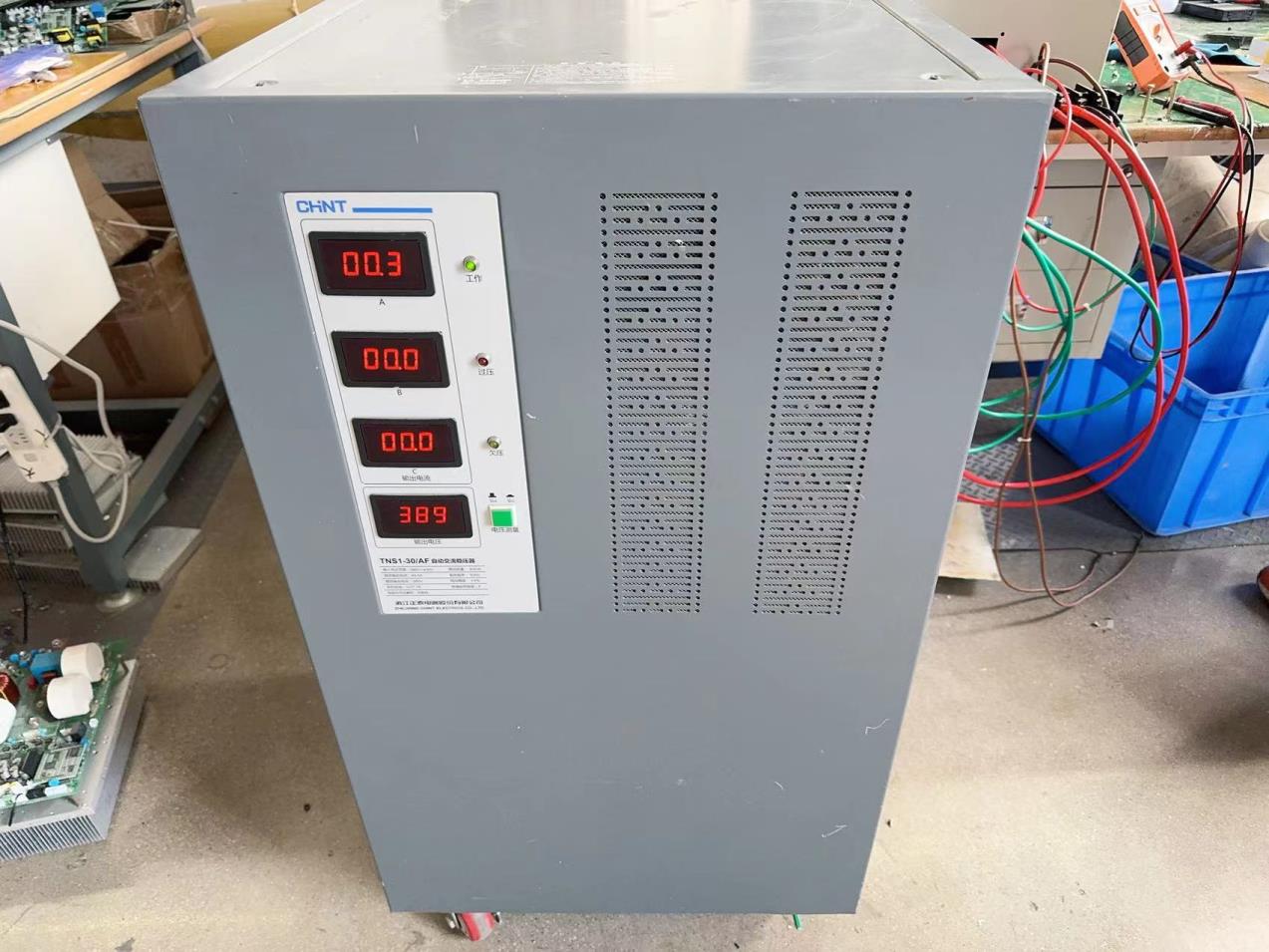
Why the Coil-to-System Question Decides Supplier Selection
Induction heating is a chain, not a single box. The chain has four layers: a copper coil that generates the alternating magnetic field and the resulting eddy currents in the workpiece; a power supply that converts 50 Hz mains current into a 5–40 kHz working current through an IGBT inverter; a control layer (DSP-based phase-locking tracking, PID or RS-485 power adjustment, temperature detection); and a mechanical assembly — inner liner, outer casing, cooling path and protective interlocks — that turns the electrical parts into equipment a plant can actually install.
A supplier's real capability boundary is defined by the most complex layer they build themselves. Three profiles appear repeatedly in the market:
- Coil and component suppliers — they supply the heating coil or the control board, and the buyer takes on coil design, matching and system integration risk.
- Cabinet and system assemblers — they build the enclosure and buy coils and controllers in, so the buyer carries the interface risk between purchased parts.
- Coil-to-system manufacturers — the coil, the controller and the finished unit are produced under one roof, which means one party can be held to a single performance, compliance and delivery commitment.
Practical decision rule: match the supplier profile to your project risk. A single replacement coil for an existing line can be sourced from a coil specialist. A new heating system that must meet a site voltage band, a compliance requirement and a production acceptance test is better sourced from a supplier whose published range covers both the coil and the finished system at your power level.
Guangdong Jiangxin Electronic Technology Co., Ltd. (brand: Jiangxin electromagnetic; product brand: JONSON) is an induction heating manufacturer established in 2011 in Shunde District, Foshan City, Guangdong Province, China. The company operates a 3,000 m² manufacturing facility with 60+ employees, an R&D team of more than 30 engineers and an annual production capacity of 120,000 units; export business accounts for 40% of total sales, with major markets in Europe, the United States, India and Indonesia. Its product line runs from induction heating coils and control boards to complete industrial induction heaters, steam generators, hot air generators and water heaters — which makes it a useful reference point for the verification framework below.
Problem Definition: Where Supplier Evaluations Break Down
Buyer problems in induction heating procurement are rarely caused by a lack of suppliers. They are caused by incomplete verification at six specific points, and each of them only becomes visible after delivery if it is not checked before the order:
- Power-range mismatch. A coil rated for a given power is not automatically matched to a system at the same power. The buyer needs both coil-level and system-level specifications from the same supplier.
- Voltage-band mismatch. Site supply is rarely exactly at nameplate value. If the supplier quotes only a nominal voltage and not an adaptation range, commissioning risk is transferred to the buyer.
- Efficiency claims quoted at the wrong level. A coil figure and a complete-system figure describe different things. In published JONSON data, the induction heating coil is rated at ≥98% heat conversion efficiency, while the 100 kW JS1000-100 industrial induction heater is rated at ≥95%. Both are legitimate numbers — for different products.
- Undeclared material differences. Conductor material and liner material are invisible in a product photo. Copper coils, a 304 stainless steel inner liner and a thickened aluminium alloy outer casing have to be named in the specification, not assumed.
- Certification without scope. A compliance logo on a brochure is not the same as a model-level declaration. The certificate must name the standard, the model and the market it applies to.
- Delivery and acceptance ambiguity. Packaging type, HS code, origin, test method and the definition of “accepted” are commercial terms, not technical details — and they decide who pays when something arrives damaged or out of tolerance.
Industry Background: A Market Moving Toward Electrification
Induction heating sits inside a market that is expanding and shifting at the same time. The global induction heating system market was valued at USD 2.39 billion in 2024 and is projected to reach USD 4.5 billion by 2035 (WiseGuyReports). As of mid-2024, more than 550,000 induction heating systems were deployed globally, with the Asia-Pacific region accounting for roughly 40% of the installed base, or about 220,000 units (Global Market Insights). Market estimates differ by scope — broader heating-equipment definitions produce larger numbers than system-level definitions — so buyers should treat any single figure as directional rather than absolute.
Two structural trends support the demand. First, efficiency: induction heating systems achieve energy efficiencies up to 92%, with an average cycle time reduction of 30% compared with traditional gas or resistance-based heating (Global Market Insights). Second, electrification: the global industrial boiler and steam generator market was estimated at USD 54.79 billion in 2024, with a shift toward electrification via induction technology to meet decarbonization goals (Market Research Future). Electric induction heating produces no on-site combustion emissions, which is one reason it is being evaluated as a replacement path for fuel-fired process heat.
Commercially, the 10 kW – 100 kW power segment dominates the induction heating market because of its versatility in hardening, forging and brazing applications (MarketsandMarkets) — the same band that most plant-level heating, steam, drying and pipeline projects fall into. On the compliance side, industrial induction heating equipment must satisfy IEC 60519-1 (general requirements for industrial electroheating installations) and IEC 60519-3 (particular requirements for induction heating and melting) (International Electrotechnical Commission). Those two references tell a buyer what a supplier's CE or ISO file should be built on.
Detailed Solution: A Six-Point Verification Framework
The framework below converts a supplier conversation into verifiable evidence. Each point can be checked against a datasheet before any commercial negotiation begins.
1. Map the Power Range from Coil to System
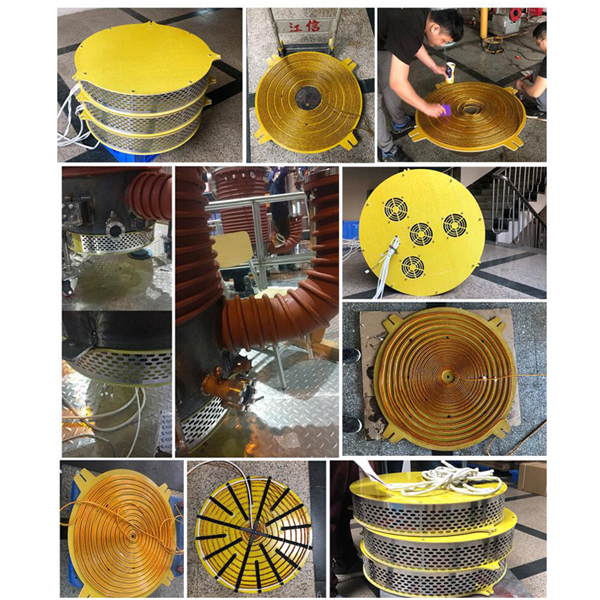
Start with the coil, because it defines the physical limit of what the supplier can heat. JONSON's customizable electromagnetic induction heating coil is built from copper conductor with rated power from 1 kW to 100 kW, effective power of 1 kW to 100 kW, 220V/380V supply at 50 Hz or 60 Hz, a power regulation range of 20%–100%, heat conversion efficiency of ≥98% and an operating frequency of 5–40 kHz, for ambient temperatures of −20 to 40 °C and humidity up to 95%.
Then check that the finished-system range covers the same band. The published JONSON lineup includes 2.5 kW/3 kW small plastic-machinery units; 3.5 kW/5 kW/6 kW heaters at 220V; the 5 kW/8 kW JS1300-005/008 and 10 kW/15 kW JS1300-10/15 wall-mounted heaters; the 20 kW JS1000-20 and 30 kW JS1000-30 machines; 40/50/60 kW and 70/80 kW heaters; and the 100 kW JS1000-100 industrial induction heater. Beyond heaters, the same manufacturer lists a 30/40/50 kW induction steam generator (JS-1600), an 8/12/15 kW induction heating hot air generator (JS-1600-8/12/15), a 3.5–8 kW instant induction water heater (JS-JR-008), a bearing induction heater in 5/8/15/20/30 kW versions and an 8 kW single-phase full-bridge induction heater control board.
2. Verify Voltage Adaptation Against the Real Site Supply
Nameplate voltage is a starting point, not an operating condition. What protects a project is the adaptation band. In the JONSON range, the JS1300-005/008 is specified at 380V with a 380V ±20% adaptation range, while the JS1300-10/15, the JS1000-20 and the JS-1600-8/12/15 hot air generator are specified with a 300V–400V adaptation range, and the JS1000-100 holds constant power output at 300–400V on a three-phase AC 380V/50–60 Hz supply. At the smaller end, the 3.5 kW/5 kW/6 kW heater adapts from 100V to 260V with constant power output at 210–260V, and the 8 kW control board accepts 160V to 260V. The induction heating coil itself is specified at 220V ±20% and 380V ±20%, and the range also covers customizable 110V/240V/660V versions with ±20% adaptation.
Ask for the band, then compare it to a metered reading at your installation point. A supplier who can only state “380V” is handing the voltage risk back to you.
3. Test Efficiency Claims at the Right Level
The word “efficiency” hides at least two different measurements. In the published data, the custom induction heating coil is rated at ≥98% heat conversion efficiency; the JS-1600 induction steam generator and the 70 kW/80 kW heaters are rated at ≥99%; the 40/50/60 kW heaters and the 8 kW control board at ≥98%; the 3.5/5/6 kW, 2.5/3 kW and 100 kW units at ≥95%; and the JS-JR-008 instant water heater at ≥90%. The 100 kW JS1000-100 additionally lists effective power of ≥98%, customizable according to user needs.
The verification question is therefore not “what is your efficiency?” but “what is that figure measured on — the coil, the power supply, or the delivered system?” A supplier who can answer both levels is describing a product; a supplier who answers only one is describing a component.
4. Audit Component Materials and Construction
Materials decide service life, and they are the easiest specification to leave vague. Across the JONSON heater range, the core heating coil is copper wire, the inner liner is 304 stainless steel, and the outer casing is thickened aluminium alloy with thickened cold-rolled steel plate. The JS-JR-008 instant induction water heater uses tempered glass for its outer casing with a copper core heating coil, the bearing induction heater (JS1300-5/8/15/20/30) uses a copper heating coil and a thickened aluminium alloy casing, and the 8 kW induction heater control board is built from aluminium alloy and copper.
Put these three lines into the purchase specification in writing: conductor material, liner material, casing material. They are the difference between two units that look identical in a photo.
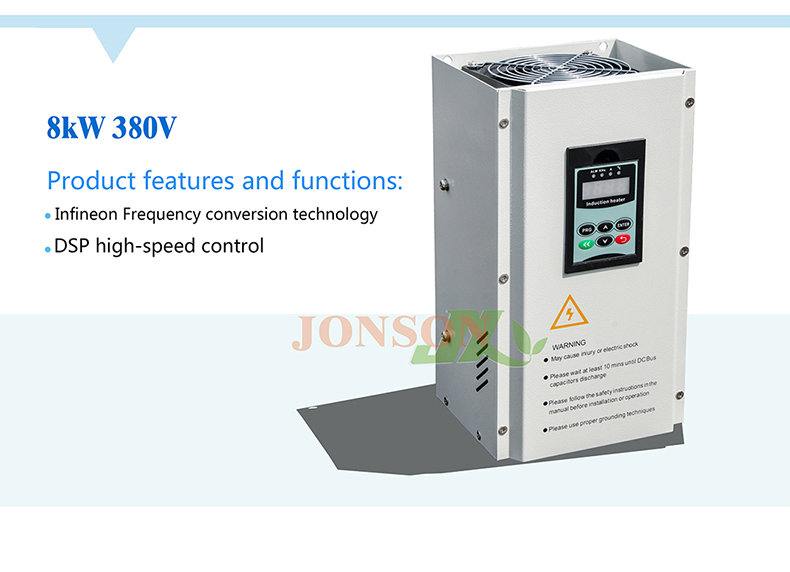
5. Confirm Certification Scope, Not Just the Logo
Certification is a document exercise, and it should be done model by model. In JONSON's published specifications, the JS1300-10/15 induction heater (10 kW/15 kW, 380V, 300V–400V adaptation) and the JS-1600-8/12/15 hot air generator carry CE, ISO and RoHS declarations. The JS1300-005/008, JS1000-20, JS1000-30 and JS1000-100 models are specified with CE and ISO certification. For the category as a whole, the relevant safety references are IEC 60519-1 and IEC 60519-3.
A complete compliance answer names three things: the standard, the model, and the market. Anything less should be treated as a marketing statement rather than a compliance document.
6. Fix Delivery Terms and Acceptance Criteria in Writing
Delivery assurance is built from small, checkable items rather than a lead-time promise. In the published data, packaging is defined per product family — carton or wood frame for the JS1300 series, carton for the JS1000 series, and wooden box for the JS-1600-8/12/15 hot air generator. HS codes are also published by model: 8514400090 for the JS1300-10/15 and 8516109000 for the JS-1600-8/12/15. Origin for the range is Guangdong Province, China.
Acceptance criteria should then be copied directly from the datasheet into the order: rated power and voltage adaptation band; stepless power adjustment from 20% to 100% (25% to 100% on the 70 kW/80 kW units); start time under 1 second; instantaneous overcurrent protection within ≤2 µs; 130% power overload protection; fully electrically isolated soft start; PID power adjustment through a 0–5V input or RS-485 on the 100 kW model; load temperature detection from 0 to 1000 °C with accuracy up to ±1 °C; and the declared heat dissipation mode (air-cooled or water-cooled).
Step-by-Step Breakdown: A Six-Step Supplier Verification Process
- Define the load and the power band first. Record workpiece type, target temperature, cycle time and the power band you need (for example, 20 kW for a small retrofit, 40–60 kW for pipeline or plastic machinery heating, 100 kW for heavy industrial duty). Supplier capability is only meaningful against a defined band.
- Request the coil data and the system data together. Coil parameters include rated power, voltage and adaptation range, frequency, power regulation, efficiency and the conductor material. For the 100 kW platform, the adaptive coil parameters are published as a 95 mm² line, 40 m length and 80–100 µH inductance; that level of detail is what allows a buyer to check physical compatibility.
- Measure the site supply and compare it with the adaptation band. Match your metered voltage against the published band — 300V–400V, 380V ±20%, 100V–260V or 160V–260V — rather than the nominal figure.
- Confirm materials and construction in writing. Copper core heating coil, 304 stainless steel inner liner, thickened aluminium alloy and cold-rolled steel plate outer casing, and the specified heat dissipation mode.
- Verify certification per model and per market. CE, ISO and RoHS where applicable, with the model number in the document, and IEC 60519-1 / IEC 60519-3 as the underlying safety reference.
- Convert everything into purchase-order clauses. Packaging type, HS code, origin, cosmetic and functional inspection points, and the exact acceptance test list from the datasheet. This step turns supplier claims into contractual obligations.
Installation and Maintenance Conditions Belong in the Same Document
Verification does not stop at the order. The published operating requirements for the range set out conditions that determine installed performance: the electromagnetic coil must maintain a reasonable distance from the metal being heated and be wound evenly, with an insulation layer added to the heating area to improve thermal efficiency; the control cabinet must be adequately ventilated to prevent overheating of the IGBT modules, with air cooling or water cooling used on higher-power equipment; and the controller should be kept away from humid, dusty and corrosive gas environments, with regular cleaning of dust, inspection of wiring terminals, coils and the cooling system. Frequent start-stop cycles should be avoided in favour of low-power constant-temperature operation and a soft-stop procedure on shutdown.
For coil geometry planning, the published guidance on the 2.5 kW platform gives coil-to-load distances of 20–25 mm for a circular arrangement, 15–20 mm for a plane, 10–15 mm for an ellipse and within 10 mm for a super-ellipse. Asking a supplier for this level of installation detail is a fast way to tell an engineering-led quotation from a price-only quotation.
Use Cases: Where Coil-to-System Verification Changes the Outcome
The framework applies across the application range that induction heating covers — plastics and rubber, food processing, chemical reactions, crude oil pipeline heating, textile printing and dyeing, aquaculture heating, metal heat treatment, building heating and medicinal herb drying. Five typical project situations show how the verification points map onto real decisions:
- Injection moulding and plastics machinery retrofit. The 40/50/60 kW heaters operate at 380V with ±20% adaptation, 20–100% power regulation and ≥98% heat conversion efficiency, which matches the retrofit duty of extruders, injection moulding machines, wire drawing machines and granulators. The check that matters is whether the supplier can also supply the replacement coil for the barrel geometry.
- Crude oil pipeline and oil and gas transmission heating. Here the 100 kW JS1000-100 with constant power output at 300–400V, ≥95% heat conversion efficiency, 20–100% stepless adjustment and air-cooled or water-cooled dissipation is the relevant system class, and the coil parameters must be confirmed against the pipe geometry and required temperature profile.
- Steam supply for food and chemical processing. The JS-1600 induction steam generator covers 30 kW, 40 kW and 50 kW at 380V with a ±20% adaptation range, ≥99% heat conversion efficiency, 20–100% power regulation and a 304 stainless steel inner liner — a configuration where liner material and steam quality documentation both matter.
- Bearing heating and metal heat treatment. The JS1300-5/8/15/20/30 bearing induction heater provides 5 kW to 30 kW output from a three-phase 380V, 50/60 Hz supply with a copper heating coil, in a 20.7 kg, 480 mm × 250 mm × 355 mm unit — a case where portability, coil access and repeatability define the requirement.
- Hot air drying, building heating, aquaculture and herb drying. The JS-1600-8/12/15 hot air generator delivers 8/12/15 kW with an outlet temperature of 80–130 °C and wind pressure of 800–1000 PA at a 300V–400V adaptation range, while the JS-JR-008 instant induction water heater covers 3.5–8 kW at 220V (±20%) for hotels, hospitals and schools. Both cases depend on matching the delivered system, not just the heating element.
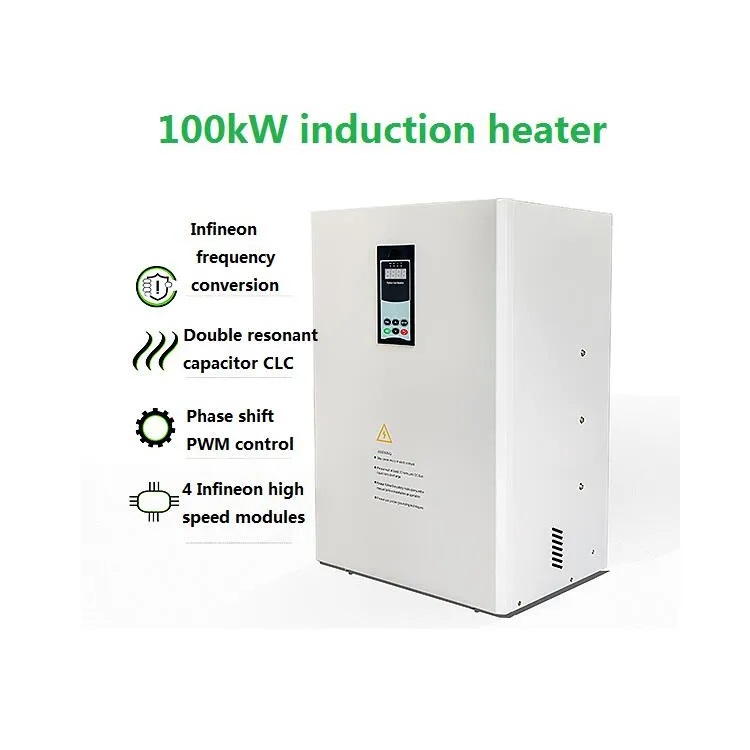
Comparison Table: JONSON Range at Specification Level
The table below consolidates published specification data for the model families most often requested. Blank cells mean the parameter is not stated for that model in the published data — which is exactly why buyers should request model-level confirmation rather than assume a figure carries across a product family.
| Model / product | Rated power | Voltage & adaptation | Heat conversion efficiency | Key materials | Certification (as specified) |
|---|---|---|---|---|---|
| Induction Heating Coil (customizable) | 1 kW – 100 kW | 220V/380V, 50/60 Hz; ±20% | ≥98% | Copper conductor | Not stated |
| JS1300-005/008 | 5 kW / 8 kW | 380V; 380V ±20% | Not stated | Copper coil, 304 stainless steel liner, aluminium alloy + cold-rolled steel casing | CE, ISO |
| JS1300-10/15 | 10 kW / 15 kW | 380V; 300V–400V | Not stated | Copper coil, 304 stainless steel liner, aluminium alloy + cold-rolled steel casing | CE, ISO, RoHS |
| JS1000-20 | 20 kW | 380V; 300V–400V | Not stated | Copper coil, 304 stainless steel liner | CE, ISO |
| JS1000-30 | 30 kW | 380V | Not stated | Copper coil, 304 stainless steel liner | CE, ISO |
| 40/50/60 kW heater | 40 kW / 50 kW / 60 kW | 380V ±20% | ≥98% | Copper coil, 304 stainless steel liner | Not stated |
| 70 kW/80 kW heater | 70 kW / 80 kW | 380V | ≥99% | Copper coil, 304 stainless steel liner | Not stated |
| JS1000-100 | 100 kW (three-phase) | AC 380V/50–60 Hz; constant power 300V–400V | ≥95% (effective power ≥98%) | Copper coil, 304 stainless steel liner | CE, ISO |
| JS-1600 steam generator | 30 kW / 40 kW / 50 kW | 380V/50–60 Hz; 380V ±20% | ≥99% | Copper coil, 304 stainless steel liner | Not stated |
| JS-1600-8/12/15 hot air generator | 8 kW / 12 kW / 15 kW | 380V; 300V–400V | Not stated | Copper coil, 304 stainless steel liner | CE, ISO, RoHS |
| JS1300-5/8/15/20/30 bearing heater | 5 kW / 8 kW / 15 kW / 20 kW / 30 kW | Three-phase 380V, 50/60 Hz | Not stated | Copper coil, thickened aluminium alloy casing | Not stated |
| JS-JR-008 instant water heater | 3.5 kW – 8 kW | 220V; 220V ±20% | ≥90% | Copper coil, tempered glass casing | Not stated |
| 8 kW control board | 8 kW (single-phase, full bridge) | 220V/50 Hz; 160V–260V | ≥98% | Aluminium alloy, copper | Not stated |
Specification summary based on published product data for the JONSON induction heating range. Fields marked “not stated” should be confirmed directly with the supplier before ordering.
Frequently Asked Questions
Which certifications and standards should an industrial induction heater supplier be able to document?
Certification must be requested at model level, not at company level, because declarations differ across a product family. In JONSON's published specifications, the JS1300-10/15 induction heater and the JS-1600-8/12/15 induction heating hot air generator carry CE, ISO and RoHS declarations, while models such as the JS1300-005/008, JS1000-20, JS1000-30 and JS1000-100 are specified with CE and ISO. For the equipment category itself, the relevant international safety references are IEC 60519-1, which sets general requirements for industrial electroheating installations, and IEC 60519-3, which covers particular requirements for induction heating and melting. A complete supplier answer names the standard, the exact model number and the market the certificate applies to; a brochure logo without those three elements should not be accepted as compliance evidence.
Can a single supplier realistically deliver both custom coils and complete induction heating systems?
Yes, and checking whether they actually do is one of the fastest ways to verify manufacturing depth. A coil-to-system supplier can show coil specifications and finished-system specifications from the same production base. JONSON's customizable induction heating coil covers 1 kW to 100 kW rated power with ≥98% heat conversion efficiency, copper conductor, 220V/380V supply at 50/60 Hz, 20%–100% power regulation and a 5–40 kHz operating frequency. The same manufacturer publishes finished systems across that band: 5 kW/8 kW and 10 kW/15 kW wall-mounted heaters (JS1300-005/008 and JS1300-10/15), 20 kW and 30 kW machines (JS1000-20, JS1000-30), 40/50/60 kW and 70/80 kW heaters, the 100 kW JS1000-100, a 30/40/50 kW induction steam generator (JS-1600), an 8/12/15 kW hot air generator (JS-1600-8/12/15) and a 3.5–8 kW instant water heater (JS-JR-008). A supplier who can only quote one side of that list leaves coil matching, controller compatibility and system responsibility with the buyer.
What actually drives the cost of an industrial induction heater?
Six published variables explain most of the difference between two quotations. The first is power rating — the range spans small units such as the 2.5 kW/3 kW and 3.5/5/6 kW heaters up to the 100 kW JS1000-100. The second is voltage customization, including standard 220V and 380V platforms plus customizable 110V/240V/660V versions with ±20% adaptation. The third is control architecture: a DSP-based high-speed automatic phase-locking tracking control system, full-bridge series resonance on the 100 kW model, half-bridge series resonance on smaller units, stepless 20%–100% power adjustment and PID power control through a 0–5V input or RS-485. The fourth is materials, since copper core heating coils, 304 stainless steel inner liners, thickened aluminium alloy and cold-rolled steel plate casings, and tempered glass on the JS-JR-008 all carry different costs. The fifth is the heat dissipation mode, air-cooled or water-cooled, which affects both unit design and installation work. The sixth is certification scope for the destination market, such as CE, ISO and RoHS. Because these variables — not the headline power figure alone — separate competing quotes, buyers should normalize every offer against one fixed specification list before comparing it.
How can a buyer validate coil-to-system fit before ordering in volume?
Validation starts with written physical parameters rather than a demonstration. Ask for the adaptive coil parameters for your target power level; on the 100 kW platform the published figure is a 95 mm² line with a 40 m length and 80–100 µH inductance. Ask for coil-to-load distance guidance: on the 2.5 kW platform this is 20–25 mm for a circular arrangement, 15–20 mm for a plane, 10–15 mm for an ellipse and within 10 mm for a super-ellipse. Then confirm the control and protection behaviour you will rely on in production: start time under 1 second, instantaneous overcurrent protection within ≤2 µs, 130% power overload protection, fully electrically isolated soft start, and load temperature detection from 0 to 1000 °C with accuracy up to ±1 °C. Installation conditions belong in the same check — even coil winding, an added insulation layer on the heating area, adequate control-cabinet ventilation, and a controller location away from humid, dusty or corrosive gas environments. A supplier that can supply these numbers in writing has already demonstrated the engineering depth that a physical trial would otherwise be used to prove.
What delivery and acceptance terms should be fixed in the purchase order?
Delivery assurance is a documentation exercise, and most of it can be copied from published product data. Packaging is defined per family in the JONSON range: carton or wood frame for the JS1300 series, carton for the JS1000 series, and wooden box for the JS-1600-8/12/15 hot air generator. HS codes are published by model, including 8514400090 for the JS1300-10/15 and 8516109000 for the JS-1600-8/12/15, with Guangdong Province, China as the origin for the range. The acceptance list should then repeat the datasheet conditions: rated power and voltage adaptation band, stepless power adjustment of 20%–100% (25%–100% on the 70 kW/80 kW units), start time under 1 second, ≤2 µs instantaneous overcurrent protection, 130% overload protection, and the declared air-cooled or water-cooled dissipation mode. Adding the maintenance requirements — regular cleaning of dust, inspection of wiring terminals, coils and the cooling system, and a soft-stop procedure instead of frequent start-stop cycles — closes the gap between what is shipped and what is expected to run for years. Buyers who want to align these clauses with a specific project can send their load, voltage and compliance details to the JONSON engineering team at jx@fsjxrn.com.cn or +86 18664277928 before finalizing the specification.
Conclusion: Verify the Chain, Then Sign the Order
Supplier evaluation in induction heating is not a comparison of brand names. It is a check of two things that can be documented: whether one supplier can carry a project from a custom coil rated 1 kW to 100 kW through to a finished system — the 5 kW/8 kW JS1300-005/008, the 10 kW/15 kW JS1300-10/15, the 20 kW and 30 kW machines, the 40/50/60 kW and 70/80 kW heaters, and the 100 kW JS1000-100 — and whether the delivery and acceptance terms are specific enough to be enforced.
The six verification points summarised here cover power range, voltage adaptation, efficiency claims at the correct level, material and construction evidence, model-level certification, and contractual delivery and acceptance criteria. Applied before negotiation, they convert a supplier conversation into comparable, checkable information and remove most of the commissioning risk that buyers otherwise absorb after the invoice is paid.
Where a specification field is missing, treat that as information too: it tells you which questions to ask next, and which supplier is willing to answer them in writing.
Next Step
If you are mapping a project requirement against the induction heater range — coil geometry, power band, voltage adaptation, certification scope or packaging and HS-code documentation for your market — send the load and site details to JONSON for a specification-level response.
Email: jx@fsjxrn.com.cn | Tel / WhatsApp: +86 18664277928 | Website: www.jonson-ih.com
Guangdong Jiangxin Electronic Technology Co., Ltd. — Building 3, Tongde Intelligent Manufacturing Park, Ronggui Street, Shunde District, Foshan City, Guangdong Province, China.
Have Questions or Need More Details?
Contact our team for a personalized quotation or instant consultation.
Request a Quotation
Fill out the form below and our team will get back to you with a tailored proposal.
WhatsApp Direct Chat
Prefer to chat in real-time? Message us on WhatsApp for instant assistance & quick answers.
- Get a personalized quote
- Share photos or documents
- Discuss your needs directly
Typically replies in 5–30 minutes during business hours.