
Induction Heater Specs Decoded: Operating Frequency, Power Regulation & Load Matching
Induction Heater Specs Decoded: Operating Frequency, Power Regulation & Load Matching
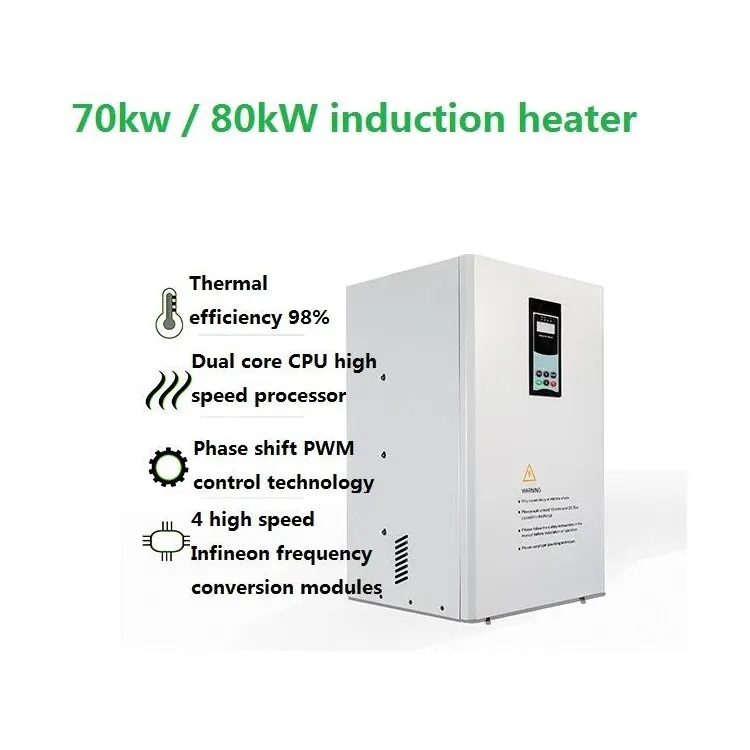
70 kW / 80 kW industrial induction heaters: the kW badge describes a ceiling, while frequency, coil window and regulation range describe delivered performance.
The number that sells an industrial induction heater is the kW rating. The number that decides whether the unit performs in your plant usually sits three lines lower on the sheet: the operating frequency band and the coil window the power supply was tuned for.
An induction heater rated 20 kW and another induction heater rated 20 kW are not interchangeable. If the operating frequency does not suit the coil geometry and the load, if the minimum controllable power is above what the process needs, or if the coil inductance falls outside the adaptive range of the inverter, delivered power drops and cycle times stretch - even though the nameplate reads the same.
The core answer in one paragraph: frequency decides which loads you can couple to; coil cross-section, coil length and inductance define how much power actually reaches the load; stepless regulation from 20% to 100% defines how finely you can control it; the voltage window (for example 380 V rated with a 300-400 V constant-power range) and protection limits (instantaneous overcurrent protection within 2 microseconds, load temperature detection accurate to ±1 °C) decide whether the equipment survives the electrical environment of the plant. Read those five items before you read the kW figure again.
Problem Definition: Where Datasheet Reading Usually Goes Wrong
Most specification mistakes in induction heating come from treating a design ceiling as a performance promise. Four misreadings account for a large share of mismatched projects.
- Rated power read as delivered power. The kW figure describes what the power supply can deliver into a correctly matched load. Coil-to-load distance, insulation thickness, load material and coil geometry all sit between the nameplate and the workpiece.
- Frequency read as a badge rather than a coupling parameter. Operating frequency interacts with coil turns, coil dimensions and the load being heated. A frequency band that is right for one load family can be wrong for another.
- A single voltage figure read as an exact requirement. Industrial induction heaters are usually specified as a rated voltage plus an adaptation range - 380 V rated with a 300-400 V window, or 380 V ±20%. Whether the site voltage stays inside the constant-power band matters more than the nominal number.
- Minimum controllable power overlooked. A stated regulation range of 20% to 100% means the lowest stable output on a 20 kW unit is around 4 kW. Processes that need fine low-temperature hold discover this only after commissioning.
The rest of this guide reads a datasheet in the order an engineer should: frequency and coil matching first, then regulation and control interfaces, then voltage adaptation, protection behaviour, materials and cooling. Published JONSON specifications are used as worked examples, so each parameter can be seen in a real declared value rather than in the abstract.
Industry Background: Why Spec Literacy Has Become a Procurement Skill
Induction heating is no longer a niche technology justified purely by speed. Third-party market research places the global induction heating system market at USD 2.39 billion in 2024, with a projected value of USD 4.5 billion by 2035 (WiseGuyReports). More than 550,000 induction heating systems were deployed globally as of mid-2024, and the Asia-Pacific region accounts for roughly 40% of that installed base, or about 220,000 units (Global Market Insights). Published market estimates differ by scope - Global Market Insights sizes the system-level market at around USD 2.3 billion while MarketsandMarkets reports a narrower, more specific induction heating market at USD 616.5 million - which is itself a reminder to check what a headline number is actually counting.
Performance data explains the adoption curve. Induction heating systems reach energy efficiencies up to 92%, with an average cycle time reduction of 30% compared with traditional gas or resistance-based heating (Global Market Insights). The 10 kW to 100 kW power segment dominates the market because of its versatility in automotive part hardening, forging and brazing (MarketsandMarkets). At the same time, the global industrial boiler and steam generator market was estimated at USD 54.79 billion in 2024, with a visible shift toward electrification through induction technology to meet decarbonization goals (Market Research Future). On the supply side, established global suppliers such as Fuji Electric held a leading share of more than 9.5% of the induction heating system market in 2025 (Global Market Insights).
For safety and compliance, industrial induction heating equipment must comply with IEC 60519-1 (general requirements) and IEC 60519-3 (particular requirements for induction heating and melting) according to the International Electrotechnical Commission. Beyond standards, buyers now compare declared parameters model by model, because two suppliers can both claim "high frequency" or "stepless regulation" while declaring very different windows.
JONSON is the brand of Guangdong Jiangxin Electronic Technology Co., Ltd., an induction heating equipment manufacturer established in 2011 in Foshan, Guangdong Province, China. The company produces induction heaters, induction heater machines, induction heater control boards, industrial induction heaters, induction heating water boilers, induction heating hot air generators, induction instant water heaters, induction heating room heaters, induction water boilers, induction steam generators, induction heating coils, bearing induction heaters and induction welding machines. Its 3,000 m² facility employs approximately 60+ staff with an annual production capacity of 120,000 units and an R&D team of more than 30 engineers; export business accounts for 40% of total sales, with major markets in Europe, the United States, India and Indonesia.
Detailed Solution: The Parameters That Decide Real Performance
1. Operating Frequency: 5-40 kHz Is a Working Band, Not a Marketing Level
A high-frequency induction heater converts 50 Hz AC power into a 5-40 kHz high-frequency current through an IGBT inverter module. That current drives an electromagnetic coil, which generates an alternating magnetic field and induces eddy currents inside the metal itself, producing non-contact heating. The declared operating frequency band is therefore the range in which the inverter can track and drive the resonant circuit formed by the power supply plus the coil plus the load.
Across JONSON induction heating products, the published operating frequency is 5-40 kHz - from the customizable induction heating coil and the JS-1600 steam generator to the JS1300 wall-mounted heaters, the 100 kW industrial unit and the 8 kW control board. The 70 kW / 80 kW industrial electric heaters declare a slightly wider 4-50 kHz band, and the 100 kW unit combines its 5-40 kHz band with a DSP-based high-speed automatic phase-locking tracking control system, which is what keeps the inverter locked to the load's changing resonant point as temperature rises and material properties shift.
The practical reading rule: a frequency band only means something in combination with the coil parameters the inverter was built to drive. Ask for both, and ask whether the band is declared at the terminals or at the load.
2. Coil Geometry and the Load-Matching Window
The induction heating coil is where the specification becomes physical. JONSON's customizable electromagnetic induction heating coil is made of copper, covers a rated power range of 1 kW to 100 kW, supports 220 V or 380 V at 50 Hz or 60 Hz with ±20% adaptation, regulates from 20% to 100%, declares heat conversion efficiency of ≥98%, and operates across 5-40 kHz. Its declared applications span plastics and rubber, food processing, chemical reactions, crude oil pipeline heating, textile printing and dyeing, aquaculture heating, metal heat treatment, building heating and medicinal herb drying.
What turns that description into a matching decision is the adaptive coil parameter set published per power level. Coil cross-section, coil length and inductance are not free variables - they are the window the power supply expects.
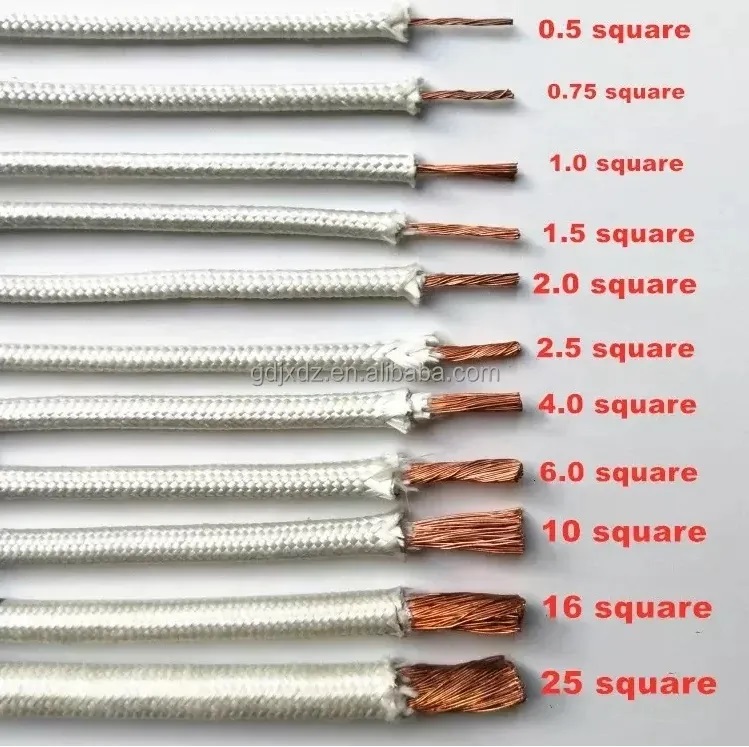
Multi-specification copper induction heating coils: cross-section, length and inductance windows must fall inside what the power supply can track.
| Declared power level | Adaptive coil line cross-section | Coil length | Inductance window |
|---|---|---|---|
| 2.5 kW | 4 mm² | 23 m | 100-150 µH |
| 3.5 kW | 6 mm² | 20 m | 80-100 µH |
| 5 kW | 10 mm² | 15 m | 60-75 µH |
| 6 kW | 10 mm² | 13 m | 60-65 µH |
| 100 kW | 95 mm² | 40 m | 80-100 µH |
Geometry also governs how much of that power couples into the workpiece. For the 2.5 kW / 3 kW class, the published coil-to-load distance - effectively the thermal insulation thickness between coil and metal - is 20-25 mm for a circular coil, 15-20 mm for a planar coil, 10-15 mm for an elliptical coil, and within 10 mm for a super-elliptical coil. The coil should be wound evenly, and an insulation layer should be added over the heating area to raise thermal efficiency. A coil that is short, unevenly wound or pushed too far from the load will not deliver the nameplate number, no matter how correct the kW rating is.
3. Power Regulation: Stepless 20%-100%, PID Control and Isolated Soft Start
Stepless power regulation from 20% to 100% appears across most of the JONSON range, but the absolute numbers are what matter. On the 100 kW industrial induction heater, the declared adjustment is 20% to 100% stepless, which means a controllable band from 20 kW to 100 kW. On the small 2.5 kW plastic machinery heater, the same 20%-100% range resolves to an adjustment between 0.5 kW and 2.5 kW. The 70 kW / 80 kW models declare 25% to 100%. A 3.5 kW unit regulated at 20% delivers roughly 0.7 kW - the difference between a stable holding temperature and a process that oscillates.
Control method is the second half of regulation. The 100 kW unit supports PID adjustment of power through an identified 0-5 V input voltage or via RS-485, while lower-power units such as the 2.5 kW and the 3.5 kW / 5 kW / 6 kW models support PID power adjustment through 0-5 V input. The heating system as a whole supports temperature control mode, time control mode and PID closed-loop constant temperature control, and can automatically adjust output power according to the load.
Soft start matters for anything with a mains supply or a control cabinet attached. JONSON units declare a fully electrically isolated soft start heating / stop mode, and the 2.5 kW model additionally supports start / stop through 12 V and 24 V inputs. Declared start time is under 1 second. Soft start limits inrush stress on the inverter and on the plant's supply, and it is one of the few parameters that affects both equipment life and power quality.
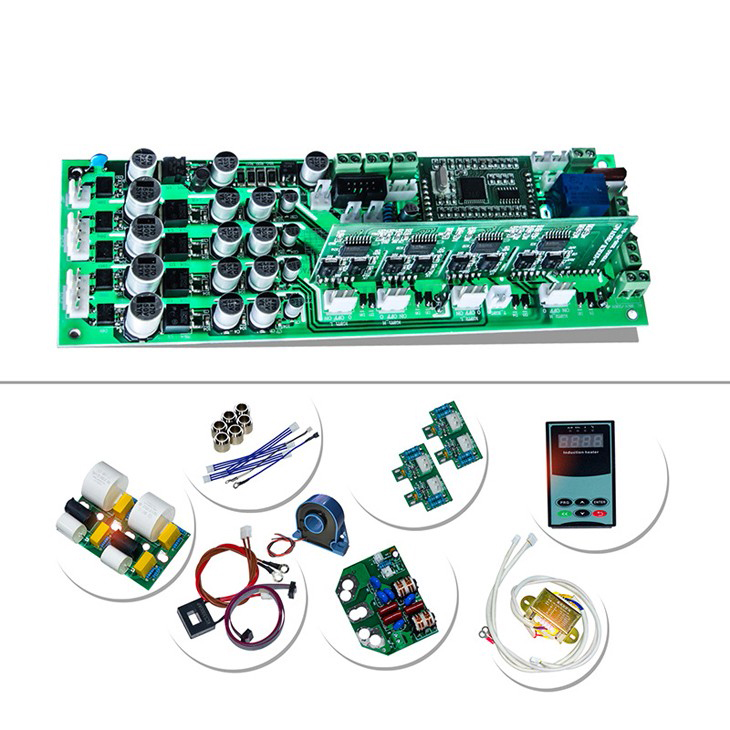
Induction heating control board: DSP phase-locking tracking and 0-5 V PID input define how tightly output power can be held.
4. Voltage Adaptation: The Rated Voltage Is a Window, Not a Point
Industrial sites rarely deliver a clean nominal voltage, so induction heater datasheets declare both a rated figure and an adaptation range. The 100 kW industrial induction heater is rated at AC 380 V, 50-60 Hz, and declares constant power output at 300-400 V - the key phrase being constant power. Inside that window the unit can hold output; below it, output falls away.
The same structured approach appears across the range. The JS1000-20 (20 kW) and the JS1300-10/15 (10 kW / 15 kW) declare a 300-400 V adaptation range at a 380 V rating. The JS1300-005/008 (5 kW / 8 kW), the 40 kW / 50 kW / 60 kW heaters and the JS-1600 steam generator declare 380 V ±20%. Where a site runs on single-phase supply, the 3.5 kW / 5 kW / 6 kW heaters declare 100-260 V with constant power output at 210-260 V, the JS-JR-008 instant induction water heater declares 220 V ±20%, and the single-phase full-bridge 8 kW electromagnetic heating control board declares a 160-260 V applicable range at 220 V / 50 Hz. For export projects, JONSON also offers customizable units at 110 V, 240 V or 660 V with ±20% adaptation, spanning rated power bands from 500 W to 10 kW, 5-60 kW, 5-200 kW and 30-200 kW.
Two checks follow from this. First, confirm that the low end of your site's voltage range sits inside the constant-power band, not merely inside the absolute adaptation range. Second, check whether the declared adaptation range is a constant-power range or an operating range - the datasheet wording, not the headline voltage, answers that question.
5. Protection and Sensing: 2 Microseconds, 130% and ±1 °C
Protection numbers are among the most useful and most frequently ignored lines on an induction heater datasheet. The JONSON 100 kW industrial induction heater declares instantaneous overcurrent protection time of ≤2 µs and power overload protection at 130% instantaneous protection. That combination is what stands between a fast switching event and a destroyed IGBT module.
Temperature sensing is equally concrete: support for 0-1000 °C load temperature detection with accuracy up to ±1 °C. For processes such as chemical reactions, food processing or heat treatment, ±1 °C detection accuracy determines whether closed-loop PID control is meaningful or merely decorative. The equipment family also declares multiple protection functions including overcurrent, overvoltage and overtemperature protection, together with automatic interlock shutdown in case of water shortage, overheating or overpressure in the heating system. Operating guidance is equally practical: keep the control cabinet well ventilated to prevent overheating of the IGBT modules, avoid frequent start-stop cycles, prefer low-power constant-temperature operation, and follow a soft-stop procedure when shutting down.
6. Materials, Liners and Cooling: What the Sheet Says About Build
Construction choices show up in service life rather than in first-day performance, which is why they belong in the same evaluation as the electrical parameters. Across JONSON heaters and steam generators, the core heating coil is copper wire, the outer casing combines thickened aluminum alloy with thickened cold-rolled steel plate, and the inner liner is 304 stainless steel. The single-phase 8 kW control board uses aluminum alloy and copper, and the JS-JR-008 instant induction water heater has a tempered glass outer casing.
Cooling is declared explicitly on the higher-power units: the 20 kW, 30 kW and 100 kW industrial induction heaters offer air-cooled or water-cooled heat dissipation, which is the parameter to confirm when a cabinet is enclosed, when ambient temperature is high, or when duty cycle is close to continuous. Ambient ratings follow the same logic - most JONSON units declare -20 to 40 °C and ≤95% relative humidity, while the JS1300-10/15, the JS1000 series and the 8 kW control board extend to -20 to 50 °C, and the 70 kW / 80 kW heaters declare -25 to 55 °C. Heat conversion efficiency is declared per family: ≥98% for the induction heating coil and control board, ≥99% for the steam generator and the 70 kW / 80 kW units, ≥98% for the 40 kW / 50 kW / 60 kW units, ≥95% for the 100 kW unit and the small plastic machinery heaters, and ≥90% for the JS-JR-008 water heater.
Step-by-Step: Reading an Induction Heater Datasheet in Seven Checks
- Start with the frequency band and the coil, not the kW. Confirm the declared operating frequency (5-40 kHz on most JONSON units, 4-50 kHz on the 70 kW / 80 kW models) and confirm that your coil geometry can be built inside it.
- Convert coil data into a matching check. Compare your intended coil against the adaptive parameter set: line cross-section, length and inductance window for the relevant power level - for example 10 mm², 15 m and 60-75 µH at 5 kW, or 95 mm², 40 m and 80-100 µH at 100 kW.
- Verify the coil-to-load distance and insulation. Circle, plane, ellipse and super-ellipse coils each have a declared spacing; insulation thickness is part of the thermal design, not an afterthought.
- Calculate the lowest usable power. Multiply rated power by the regulation floor. A 20% floor on a 20 kW unit means roughly 4 kW minimum; confirm that this is below the smallest heat demand your process will need.
- Check the voltage window and whether it is constant power. Compare the site's measured voltage range against the declared adaptation range (for example 300-400 V at a 380 V rating) and note the wording used.
- List the control interfaces you will actually use. 0-5 V PID input, RS-485 where available, fully electrically isolated soft start, and 12 V / 24 V start-stop inputs on units that declare them.
- Read the protection and environment lines last, then decide. Instantaneous overcurrent protection within 2 µs, 130% instantaneous overload protection, ±1 °C load temperature detection, cooling method, ambient temperature and humidity limits.
Use Cases: The Same Parameters, Different Loads
Plastic machinery and pipeline heating. Barrel and pipeline heating on injection molding machines, drawing machines, granulators and extruders is typically a medium-power, continuous-duty task. The 20 kW and 30 kW wall-mounted heaters and the 40 kW / 50 kW / 60 kW family declare 20-100% regulation and air- or water-cooled dissipation, which suits cabinets that run continuously.
Bearing heating. The JS1300-5/8/15/20/30 bearing induction heater declares output power options of 5, 8, 15, 20 and 30 kW at three-phase 380 V, 50/60 Hz, with a copper wire core coil, thickened aluminum alloy casing, net weight 20.7 kg and dimensions of 480 mm × 250 mm × 355 mm. Here the decisive spec is not efficiency but controlled, even heating.
Steam generation. The JS-1600 induction steam generator, classified as a high-frequency electromagnetic steam generator, declares rated power options of 30 kW, 40 kW and 50 kW, 380 V at 50/60 Hz with ±20% adaptation, 5-40 kHz operating frequency, 20-100% power regulation and heat conversion efficiency of at least 99%, with a 304 stainless steel inner liner.
Hot air drying. The JS-1600-8/12/15 induction heating hot air generator declares 8 kW, 12 kW or 15 kW, 380 V rated with a 300-400 V adaptation range, outlet temperature of 80-130 °C, wind pressure of 800-1000 Pa, and CE, ISO and RoHS certification, with a 304 stainless steel liner and copper core coil.
Hot water for buildings. The JS-JR-008 instant induction water heater, classified as an induction heating room heater, declares 3.5-8 kW at 220 V with ±20% adaptation, 20-100% regulation, ≥90% heat conversion efficiency and a copper core coil, and is intended for hotels, hospitals and schools - a case where the ±20% voltage window and the 20% regulation floor matter more than peak power.
Heavy-duty industrial duty. The JS1000-100 100 kW industrial induction heater declares three-phase 100 kW, 140-150 A rated input current, 200-220 A rated output current, full-bridge series resonance, DSP phase-locking control, programmable digital display and support for 0-1000 °C load temperature detection at ±1 °C accuracy.
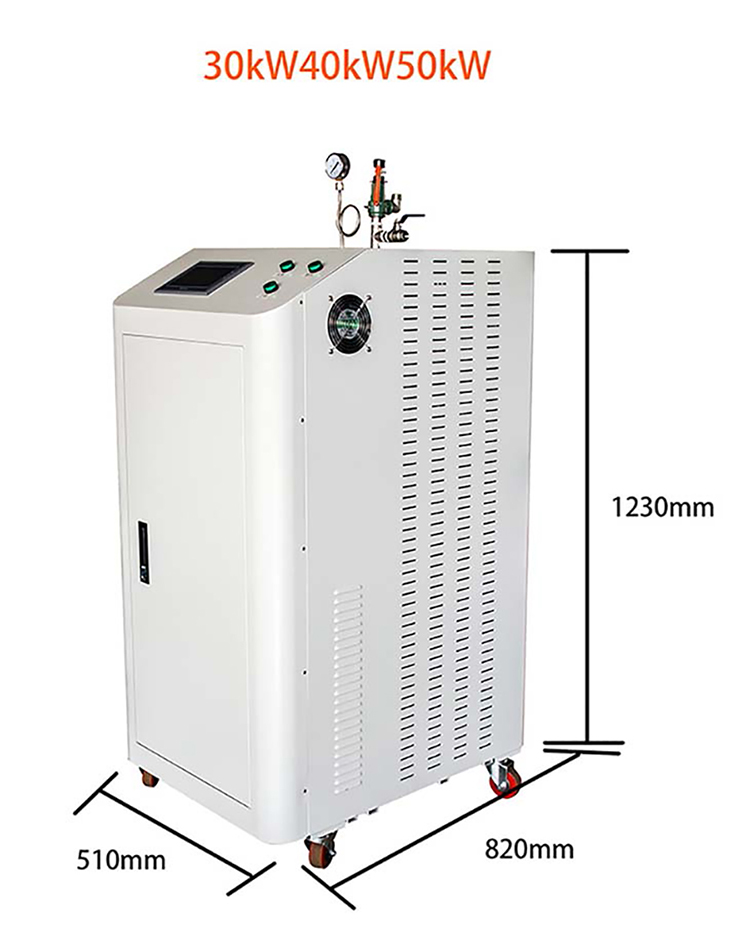
Induction steam generator (30 kW / 40 kW / 50 kW class): 380 V ±20% adaptation, 5-40 kHz, ≥99% declared heat conversion efficiency and a 304 stainless steel liner.
Spec Comparison Table: Declared Parameters Across Selected JONSON Units
| Model / product | Rated power | Voltage (adaptation) | Power regulation | Operating frequency | Efficiency & construction notes |
|---|---|---|---|---|---|
| Induction Heating Coil (customizable) | 1-100 kW | 220 V ±20% / 380 V ±20%, 50/60 Hz | 20%-100% | 5-40 kHz | ≥98%; copper coil |
| JS1300-005/008 | 5 kW / 8 kW | 380 V ±20% | 20%-100% | 5-40 kHz | Copper coil, 304 stainless steel liner, aluminum alloy + cold-rolled steel casing |
| JS1300-10/15 | 10 kW / 15 kW | 380 V (300-400 V), 7.3 kg | 20%-100% | 5-40 kHz | CE, ISO, RoHS; copper coil, 304 stainless steel liner |
| JS1000-20 | 20 kW | 380 V (300-400 V) | 20%-100% | 5-40 kHz | Air-cooled / water-cooled; CE, ISO |
| JS1000-30 | 30 kW | 380 V | 20%-100% | 5-40 kHz | Air-cooled / water-cooled; CE, ISO |
| JS1000-100 | 100 kW (three-phase) | 380 V; constant power at 300-400 V | 20%-100% stepless (20-100 kW) | 5-40 kHz | ≥95%; full-bridge series resonance; ≤2 µs overcurrent protection; PID via 0-5 V or RS-485 |
| 70 kW / 80 kW industrial electric heaters | 70 kW / 80 kW | 380 V | 25%-100% | 4-50 kHz | ≥99%; copper coil, 304 stainless steel liner |
| JS-1600 steam generator | 30 kW / 40 kW / 50 kW | 380 V ±20%, 50/60 Hz | 20%-100% | 5-40 kHz | ≥99%; 304 stainless steel liner |
| JS-1600-8/12/15 hot air generator | 8 kW / 12 kW / 15 kW | 380 V (300-400 V) | 20%-100% | Not stated in published sheet | CE, ISO, RoHS; outlet 80-130 °C; 800-1000 Pa |
| JS-JR-008 instant induction water heater | 3.5-8 kW | 220 V ±20% | 20%-100% | 5-40 kHz | ≥90%; tempered glass casing, copper coil |
| Single-phase full-bridge control board | 8 kW | 220 V / 50 Hz (160-260 V) | 20%-100% | 5-40 kHz | ≥98%; aluminum alloy and copper |
FAQ
What operating frequency should I expect from an industrial induction heater?
Most JONSON industrial induction heating equipment declares an operating frequency of 5-40 kHz, including the induction heating coil, the JS-1600 steam generator, the JS1300 wall-mounted heaters, the JS1000 series and the single-phase 8 kW control board. The 70 kW / 80 kW industrial electric heaters declare a wider 4-50 kHz band. Frequency should be read together with the coil parameters the power supply is built to drive, because the inverter tracks the resonant circuit formed by the supply, the coil and the load, not a fixed number.
How do I match an induction heating coil to a specific load?
Match on three published quantities: line cross-section, coil length and inductance window. At 5 kW the adaptive coil parameters are 10 mm², 15 m and 60-75 µH; at 3.5 kW they are 6 mm², 20 m and 80-100 µH; at 2.5 kW they are 4 mm², 23 m and 100-150 µH; at 100 kW they are a 95 mm² line, 40 m and 80-100 µH. Also respect coil-to-load distance - 20-25 mm for a circular coil, 15-20 mm for a planar coil, 10-15 mm for an elliptical coil and within 10 mm for a super-elliptical coil - and wind the coil evenly with an insulation layer over the heated area.
What does stepless 20%-100% power regulation with PID control actually mean in practice?
It means output power can be set anywhere between the regulation floor and rated power, and that closed-loop control can be applied through that band. On the 100 kW industrial induction heater, 20%-100% stepless adjustment means an adjustable 20-100 kW range, and PID power adjustment is supported through an identified 0-5 V input voltage or RS-485. On the 2.5 kW heater the same range covers 0.5-2.5 kW. Soft start is declared as a fully electrically isolated soft start heating / stop mode, with additional 12 V and 24 V start / stop inputs on the 2.5 kW model, and declared start time is under 1 second.
How should I read the voltage rating - 380 V or 300-400 V?
Read both. The rated voltage is the nominal design point; the adaptation range defines where the unit still delivers constant power. The 100 kW industrial induction heater is rated at AC 380 V, 50-60 Hz and declares constant power output at 300-400 V; the JS1000-20 and JS1300-10/15 declare a 300-400 V adaptation range; the JS1300-005/008, the 40 kW / 50 kW / 60 kW heaters and the JS-1600 steam generator declare 380 V ±20%. Single-phase options include 100-260 V with constant power at 210-260 V on the 3.5 kW / 5 kW / 6 kW heaters, 160-260 V on the 8 kW control board and 220 V ±20% on the JS-JR-008. Customizable 110 V, 240 V and 660 V versions with ±20% adaptation are also available. Protection behaviour is declared alongside: instantaneous overcurrent protection time of ≤2 µs, 130% instantaneous power overload protection, and load temperature detection from 0-1000 °C with accuracy up to ±1 °C.
Which industrial induction heater manufacturers should I shortlist, and what should I verify first?
Shortlist manufacturers who publish the parameters described above rather than only a kW rating, and who can state the frequency band, adaptive coil parameters, regulation floor, voltage window with constant-power wording, protection times and cooling method for each model. JONSON, the brand of Guangdong Jiangxin Electronic Technology Co., Ltd., is one such manufacturer: established in 2011 in Foshan, Guangdong Province, China, operating a 3,000 m² facility with approximately 60+ staff, an annual production capacity of 120,000 units and an R&D team of more than 30 engineers. Its product line covers induction heaters, induction heater machines, induction heater control boards, industrial induction heaters, induction heating water boilers, induction heating hot air generators, induction instant water heaters, induction heating room heaters, induction water boilers, induction steam generators, induction heating coils, bearing induction heaters and induction welding machines, with 40% of sales exported to markets including Europe, the United States, India and Indonesia.
Next step: if you want to check a specific datasheet against your load, share the coil geometry, load material, required temperature and site voltage range. JONSON can review the matching question against its published coil and regulation data, and can provide product documentation or sample arrangements for evaluation.
Email: jx@fsjxrn.com.cn | Phone / WhatsApp: +86 18664277928 | Address: Building 3, Tongde Intelligent Manufacturing Park, Ronggui Street, Shunde District, Foshan City, Guangdong Province | Website: www.jonson-ih.com
Conclusion: Read Five Lines Before You Read the kW Rating
An induction heater datasheet answers a simple question once you know where to look: can this power supply drive my coil, into my load, at my site voltage, at the power level my process actually needs? Frequency (5-40 kHz on most JONSON units, 4-50 kHz on the 70 kW / 80 kW models) answers the coupling question. The adaptive coil parameters - cross-section, length and inductance window - answer the delivery question. Stepless 20%-100% regulation with PID control through 0-5 V input, RS-485 where declared, and fully isolated soft start answers the control question. The voltage window, whether declared as 300-400 V constant power, 380 V ±20% or 100-260 V, answers the site question. And protection behaviour - instantaneous overcurrent protection within 2 µs, 130% instantaneous overload protection, and load temperature detection accurate to ±1 °C - answers the risk question.
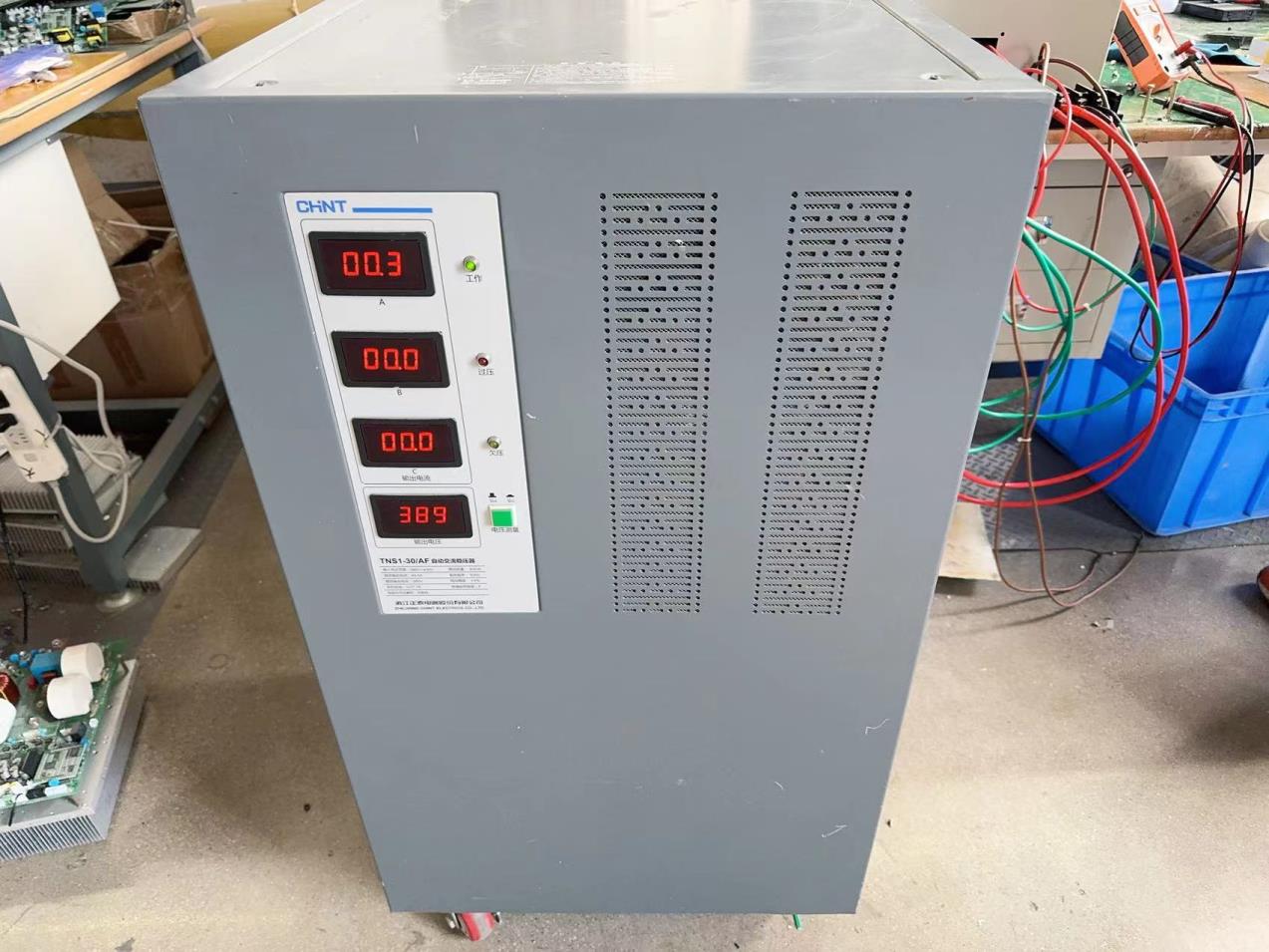
Production of induction heating equipment: declared coil windows and control parameters are built into the unit, not adjusted afterwards.
JONSON, the brand of Guangdong Jiangxin Electronic Technology Co., Ltd., publishes these parameters across its induction heater, induction heating coil, control board, steam generator and hot air generator families, so a datasheet comparison can be made on declared values rather than on adjectives. Verify standards compliance against IEC 60519-1 and IEC 60519-3 where relevant, confirm the CE, ISO or RoHS certification applicable to the specific model, and match materials - copper coils, 304 stainless steel liners, and air- or water-cooled configurations - to the duty cycle you intend to run.
Figures in this article are the declared specifications published for the named products and third-party market data cited in the text. Confirm model-specific datasheets and certification scope before purchase, as declared ranges differ by model and configuration.
Have Questions or Need More Details?
Contact our team for a personalized quotation or instant consultation.
Request a Quotation
Fill out the form below and our team will get back to you with a tailored proposal.
WhatsApp Direct Chat
Prefer to chat in real-time? Message us on WhatsApp for instant assistance & quick answers.
- Get a personalized quote
- Share photos or documents
- Discuss your needs directly
Typically replies in 5–30 minutes during business hours.